A security tool can detect a threat, but who investigates the alert when your IT team is already handling other problems? And who takes action when an attack happens outside business hours?
These questions explain the difference between EDR and MDR. Endpoint Detection and Response (EDR) provides technology to monitor devices and respond to threats. Managed Detection and Response (MDR) adds security experts who monitor, investigate, and help respond to threats under an agreed service scope.
The right choice depends on your team’s skills, available resources, and security needs. Let’s compare both approaches and see when using them together makes sense.
What is EDR and How Does It Protect Endpoints?

In the EDR vs MDR comparison, Endpoint Detection and Response (EDR) is a security technology that monitors endpoint activity to detect, investigate, and respond to threats. Endpoints include laptops, desktop computers, and servers that connect to a business network.
EDR tools can help security teams:
Detecting suspicious activity:
Identify unusual processes, file changes, and other signs of an attack.
Investigate alerts:
Review activity and gather evidence to understand what happened.
Contain threats:
Support actions such as isolating a device or stopping a malicious process, depending on the tool’s capabilities and configuration.
Track attack activity:
Connect related alerts to help analysts understand how an incident developed.
For example, an employee may open a file that starts running suspicious commands. EDR can flag the activity, provide details for investigation, and support action to contain the threat.
However, having EDR does not mean every alert will be investigated immediately. Your organization still needs people, processes, and suitable configurations to manage alerts and respond effectively. Automation can handle some tasks, but complex incidents may need human judgment.
What is MDR and What Does the Service Include?
Managed Detection and Response (MDR) is a cybersecurity service in which external security experts help monitor, investigate, and respond to threats. Providers use security tools, threat data, and trained analysts to help businesses identify and handle suspicious activity.
Depending on the service agreement, MDR may include:
- Continuous monitoring: Reviewing security alerts across the agreed coverage period.
- Alert investigation: Checking whether suspicious activity indicates a genuine threat.
- Threat hunting: Looking for signs of attacks that automated alerts may miss. Learn more about EDR threat hunting to understand how security teams search for hidden threats.
- Incident response support: Recommending or carrying out agreed actions to contain threats.
- Reporting and guidance: Sharing findings and suggesting ways to improve security.
MDR analysts monitor alerts, investigate threats, and help the internal team respond. Depending on the service agreement, they may also take action to contain threats. MDR can support a company’s security team without replacing it.
MDR services vary in what they cover. Some monitor only certain security tools, while others cover devices, networks, cloud systems, and user accounts. Before choosing a provider, check which systems it protects, which threats it handles, and what actions it can take.
What is the Difference Between EDR and MDR?
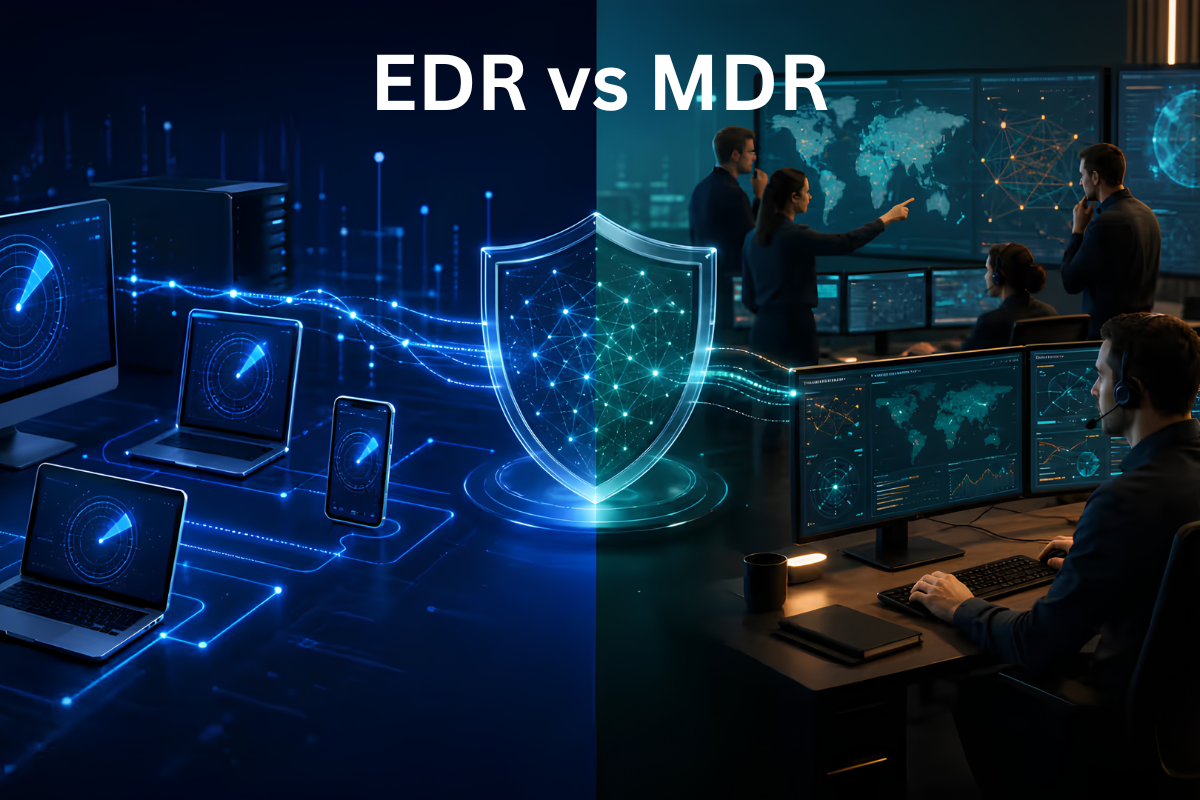
The main difference is that EDR is a technology, while MDR is a managed service. EDR gives a security team tools to detect and respond to endpoint threats. MDR adds people and operational support to help manage that work.
| Comparison factor | EDR | MDR |
| Primary role | Endpoint detection and response technology | Managed detection and response service |
| Main focus | Monitoring endpoint activity and detecting threats | Monitoring, investigating, and responding within the agreed scope |
| Daily operation | Usually managed by the organization’s team | Managed by an external provider, often with customer involvement |
| Staffing needs | Requires internal skills and capacity | Adds external security expertise |
| Monitoring | Depends on how the organization operates the tool | Depends on the provider’s coverage and service terms |
| Incident response | Tool-supported actions and internal response processes | Provider guidance or direct action, as contracted |
| Cost structure | Licensing, deployment, and operating costs | Service fees and any additional tool or service costs |
| Best suited to | Teams able to manage endpoint security internally | Teams needing external monitoring and response support |
Neither option is automatically better for every business. The right choice in EDR vs MDR depends on whether your team has the skills and time to manage security alerts or needs external experts to investigate and respond to threats.
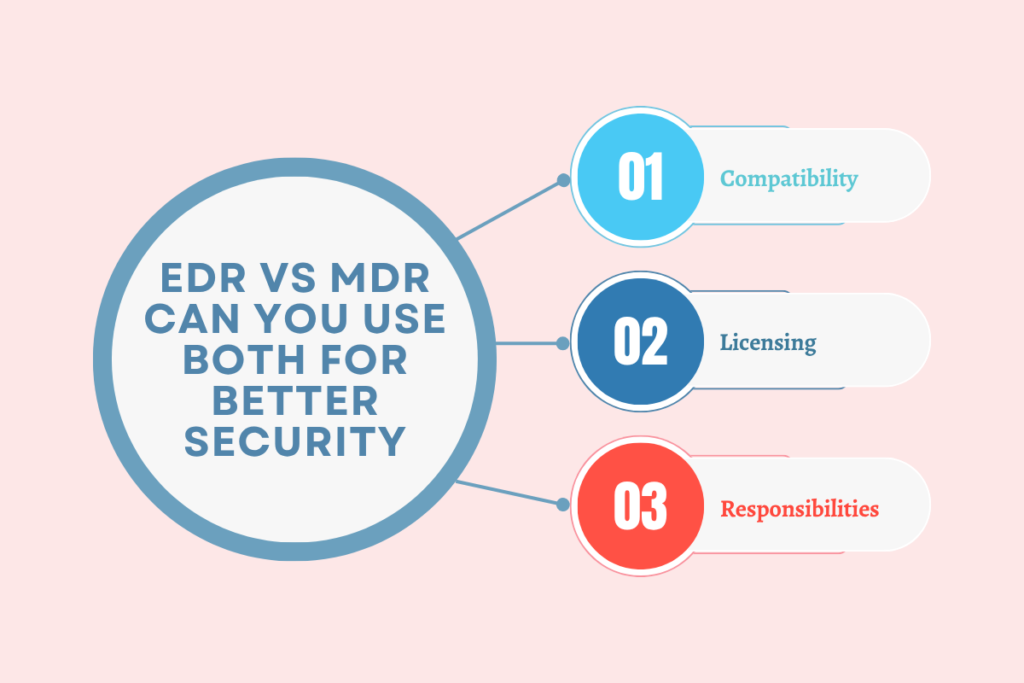
EDR vs MDR: Can You Use Both for Better Security?
Yes. A business can use EDR technology while an MDR provider helps manage monitoring, investigation, and response. This setup allows the organization to retain its endpoint security tools while adding outside expertise.
Consider a business that already uses EDR but has a small security team. The tool detects suspicious activity on an employee’s laptop late at night. The MDR provider can investigate the alert, check related evidence, and recommend or carry out approved containment actions.
This arrangement can help the business make better use of its existing security tools without building a full internal monitoring team.
However, check three things before combining EDR and MDR:
- Compatibility: Confirm that the provider supports your existing EDR platform.
- Licensing: Check whether your current license covers the required features and integrations.
- Responsibilities: Agree on who investigates alerts, approves containment, communicates with management, and handles recovery.
Also confirm whether the MDR provider can act directly on your systems or must wait for your team to approve each action. These details can affect how quickly your business responds to a threat.
When Should a Business Choose EDR Over MDR?

EDR may be a good fit when a business has the staff, skills, and processes to manage endpoint security internally. The team must be able to review alerts, investigate threats, and respond when needed.
Understanding how Endpoint Detection and Response works can help your team assess whether it has the skills and processes to manage alerts and respond to threats internally.
Consider EDR managed internally when:
- Your security team has the right skills. Analysts can investigate alerts and manage endpoint threats.
- You have suitable monitoring coverage. Your team can review important alerts during the hours your business requires.
- You need direct control. Your organization wants to manage detection rules, investigations, and response actions.
- You have established response processes. Staff know how to contain threats, document incidents, and restore affected systems.
For example, a large business with an established SOC may already have trained analysts, defined escalation rules, and incident response procedures. It may be able to operate EDR effectively without outsourcing the entire detection and response process.
Still, internal ownership does not guarantee better protection. If alerts remain uninvestigated or response is delayed because the team lacks capacity, the organization may need additional support.
When Should a Business Consider MDR?
A business should consider MDR when its internal team lacks the time, skills, or staff to manage security threats effectively.
MDR may be a good fit when:
- Your team is short on time. Staff cannot investigate every alert.
- You need after-hours monitoring. Your team cannot monitor threats around the clock.
- You receive too many alerts. Your team needs help finding real threats.
- You lack security skills. Your team needs expert help with threat detection and investigation.
- You need help responding. Your team needs support to contain threats quickly.
For example, a business may use EDR but lack security experts to review alerts. MDR gives it access to experts who investigate threats and help the team respond.
Before choosing a provider, check its monitoring hours, the systems it covers, the actions it can take, your team’s responsibilities, and the total cost. These details clarify what the service includes and what your team must handle.
Conclusion:
Choosing between EDR vs MDR depends on your team’s skills, resources, and security needs. EDR provides tools to detect and respond to endpoint threats, while MDR adds expert support to monitor, investigate, and manage threats. Some businesses may benefit from using both. To understand how EDR supports your wider security strategy, learn more about Endpoint Detection and Response.
Frequently Asked Questions
1. Does MDR replace an in-house security operations center?
Not always. MDR can handle agreed monitoring and investigation tasks while an internal SOC manages other security work.
2. Can an MDR provider use my existing EDR license?
Sometimes. In the EDR vs MDR setup, compatibility depends on the provider, your license terms, and the features required. Confirm these before signing a contract.
3. Who owns incident response decisions when a business uses MDR?
Responsibility depends on the service agreement. The provider may investigate and recommend actions, while your team approves certain steps. Some services allow the provider to take agreed actions directly.
4. Does MDR protect cloud workloads and networks as well as endpoints?
Not always. Some MDR services cover endpoints only, while others include network, identity, or cloud data. Check the provider’s exact coverage and exclusions.
5. What questions should I ask an MDR provider before signing a contract?
Ask about monitoring hours, escalation times, response authority, supported systems, service exclusions, reporting, and extra fees. Make sure these terms are documented in the contract.