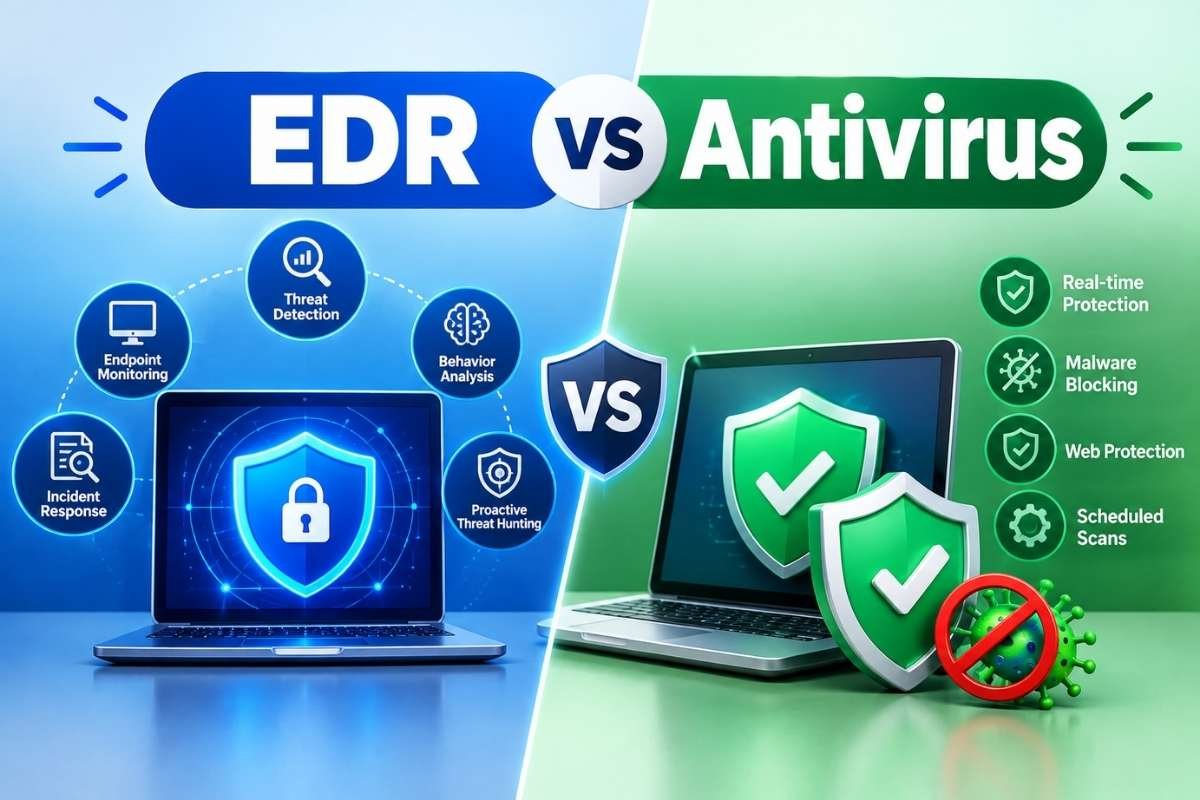
Antivirus can stop a malicious file before it causes harm. But what happens when suspicious activity gets past that protection?
That is where the difference between EDR vs antivirus becomes important. Antivirus focuses mainly on preventing and blocking malware, while EDR gives security teams deeper visibility into endpoint activity so they can detect, investigate, and respond to threats.
The right choice depends on the risks your business faces and how much visibility and response your security team needs.
What is the Difference Between EDR vs Antivirus?
The simplest difference is their primary role.
Antivirus is designed to detect and block malware on a device. It can scan files, monitor activity, quarantine threats, and use methods such as behavior-based detection and cloud-based analysis.
EDR goes further by collecting endpoint security data and helping teams investigate suspicious activity. Microsoft describes EDR as a capability that provides deep visibility into endpoint activity and supports rapid investigation and response.
This does not mean modern antivirus only looks for known viruses. Current antivirus products can detect new and changing threats through several methods. The key difference is how much context security teams get when something suspicious happens and what they can do next.
EDR vs Antivirus: How Do They Compare?
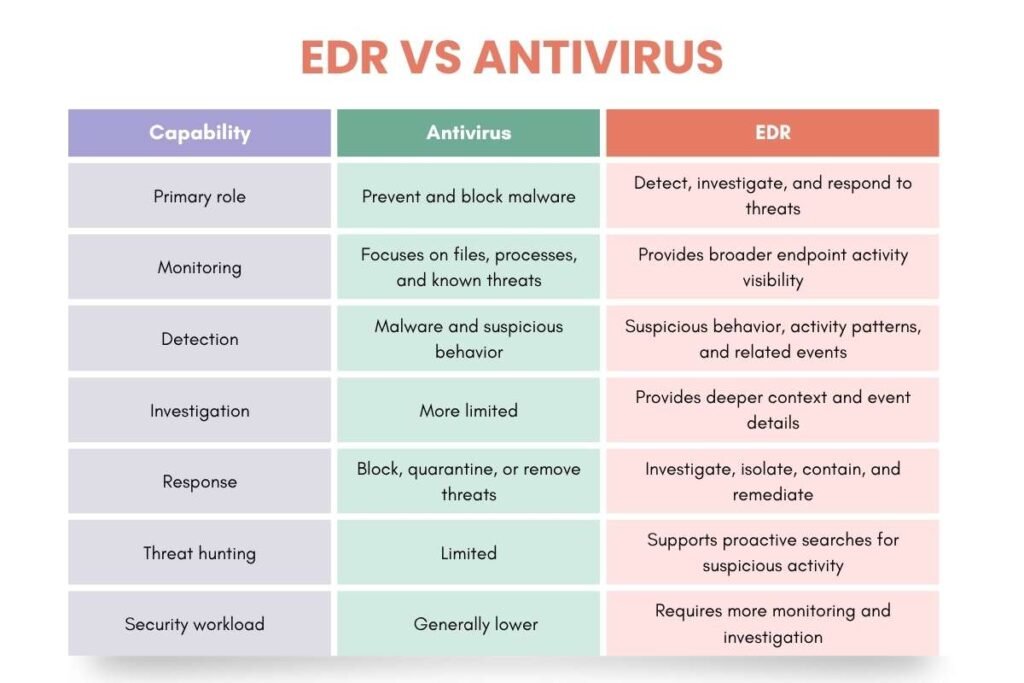
| Capability | Antivirus | EDR |
| Primary role | Prevent and block malware | Detect, investigate, and respond to threats |
| Monitoring | Focuses on files, processes, and known threats | Provides broader endpoint activity visibility |
| Detection | Malware and suspicious behavior | Suspicious behavior, activity patterns, and related events |
| Investigation | More limited | Provides deeper context and event details |
| Response | Block, quarantine, or remove threats | Investigate, isolate, contain, and remediate |
| Threat hunting | Limited | Supports proactive searches for suspicious activity |
| Security workload | Generally lower | Requires more monitoring and investigation |
NIST separates antivirus policies from EDR policies in its Zero Trust guidance. It describes antivirus as protection against threats and malware, while EDR policies are used to detect advanced attacks in near real time.
The difference is therefore not simply about which tool detects more threats. It is also about what security teams can see and do after detection.
How Does Antivirus Protect an Endpoint?
Antivirus works mainly as a prevention and blocking layer.
It can scan files and processes, identify malicious software, and stop or quarantine threats. Modern antivirus can also use behavior-based detection, cloud-delivered protection, and other methods to detect threats that do not match a simple known signature.
For many businesses, this provides an important first layer of endpoint protection. CISA also recommends keeping antivirus and anti-malware software updated and properly configured.
But prevention is only part of the problem. If an attacker gets around those controls, security teams may need more information about what happened on the device.
EDR vs Antivirus: What Happens Beyond Malware Detection?

EDR adds continuous endpoint visibility and tools for investigation and response.
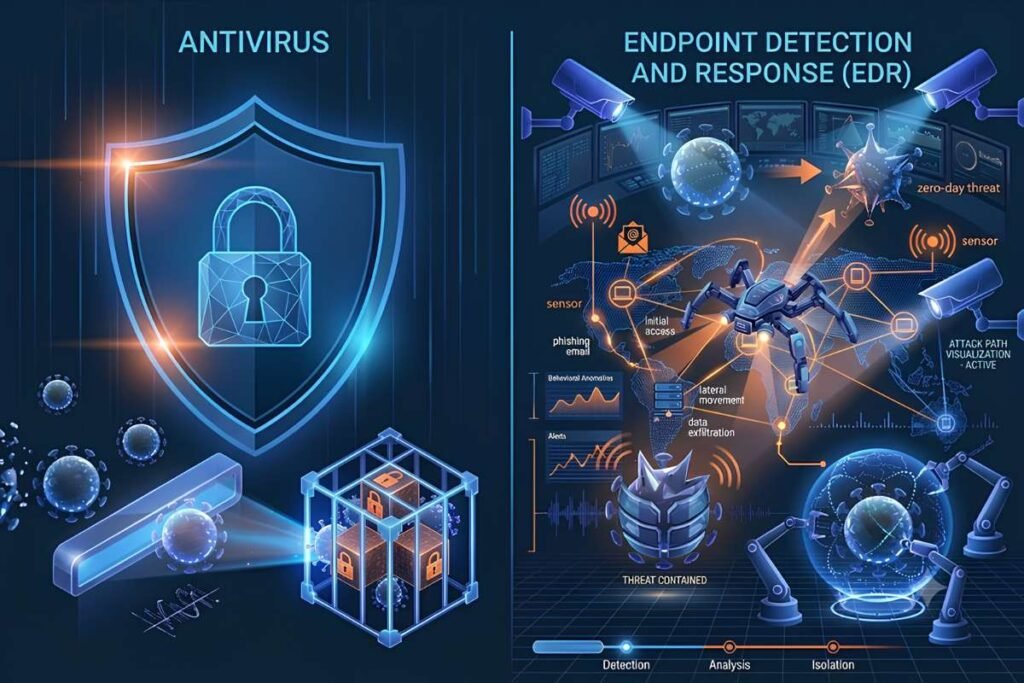
Instead of focusing mainly on whether a file or process is malicious, EDR can help analysts understand the activity around a suspicious event through its underlying EDR technology and architecture. This can include related processes, connections, user activity, and other endpoint events.
That additional context can help teams answer questions such as:
- What happened on the device?
- When did the suspicious activity begin?
- What other activity is linked to it?
- Has the threat affected other devices?
- Should the device be isolated?
EDR is a way to monitor and control endpoint devices across detection, response, and follow-up analysis.
This is especially useful when a threat does not look like a traditional malware infection.
What Happens When a Threat Gets Past Antivirus?
This is where the practical difference between the two becomes clearer.
Imagine an employee opens a file that starts a suspicious process. Antivirus may detect and block the malicious activity. If the activity is not blocked, however, the security team may need to understand what happened and whether the attacker gained further access.
EDR can provide additional endpoint information for that investigation. It can also support actions such as isolating a device and collecting information for analysis.
For a broader incident, these actions should fit into the organization’s incident response plan, rather than operate as a separate process.
Can EDR Replace Antivirus?
Not always. EDR and antivirus can overlap, but they are not automatically interchangeable.
Modern endpoint security platforms may combine antivirus, EDR, and other controls in one product. Microsoft, for example, describes Defender for Endpoint as combining next-generation antivirus with EDR and other security capabilities.
In some setups, EDR can also provide additional protection when another antivirus product is the primary protection.
The important point is to check what the specific product actually includes. A business should not assume that buying an EDR product automatically provides every antivirus capability it needs.
Which is Better for Your Organization: EDR vs Antivirus?
There is no need to choose based on which technology sounds more advanced. Start with the security problem you need to solve.
Antivirus may be enough when:
- Your main need is basic malware prevention and blocking.
- Your security team has limited time for continuous monitoring.
- You need a simpler endpoint security setup.
EDR may be a better fit when:
- You need broader visibility into endpoint activity.
- Your team needs to investigate suspicious behavior.
- Threat hunting is part of your security process.
- You need deeper investigation and device containment during an incident.
Using both may make sense when you want malware protection alongside deeper detection and response. The right setup depends on what the specific security platform includes.
A small organization with limited security staff may first need strong antivirus protection and basic endpoint controls. A business facing more complex threats or needing deeper investigation may benefit from EDR.
The final decision should consider endpoint risk, security team capacity, incident response needs, and existing security tools.
Conclusion
The main difference between EDR and antivirus is what happens when a threat appears.
Antivirus focuses on preventing, detecting, and blocking malware. EDR adds deeper endpoint visibility so security teams can detect suspicious activity, investigate what happened, and take response actions. For a broader look at the technology, understanding Endpoint Detection and Response can help put these capabilities in context.
Neither approach should be judged by the number of features it has. The better choice is the one that matches the organization’s risks and gives its security team the protection and visibility it can actually use.
FAQs
Can EDR and antivirus run on the same device?
Is EDR necessary for a small business when comparing EDR vs Antivirus?
Not every small business needs EDR. The decision depends on its risk, endpoints, sensitive data, security requirements, and ability to monitor and respond to alerts.
Does EDR slow down computers more than antivirus?
Performance depends on the product and its settings. Security teams should test endpoint impact before deploying either technology widely.
How does EDR vs Antivirus handle fileless malware?
Antivirus tools may detect fileless attacks through behavioral and memory-based detection. EDR adds context about suspicious processes and endpoint activity, helping security teams investigate activity that may evade basic protection.