An EDR platform is only as useful as the architecture behind it. If an endpoint cannot collect useful security data, the detection layer has less information to work with. If that data cannot be searched or linked to other events, analysts may struggle to understand an attack.
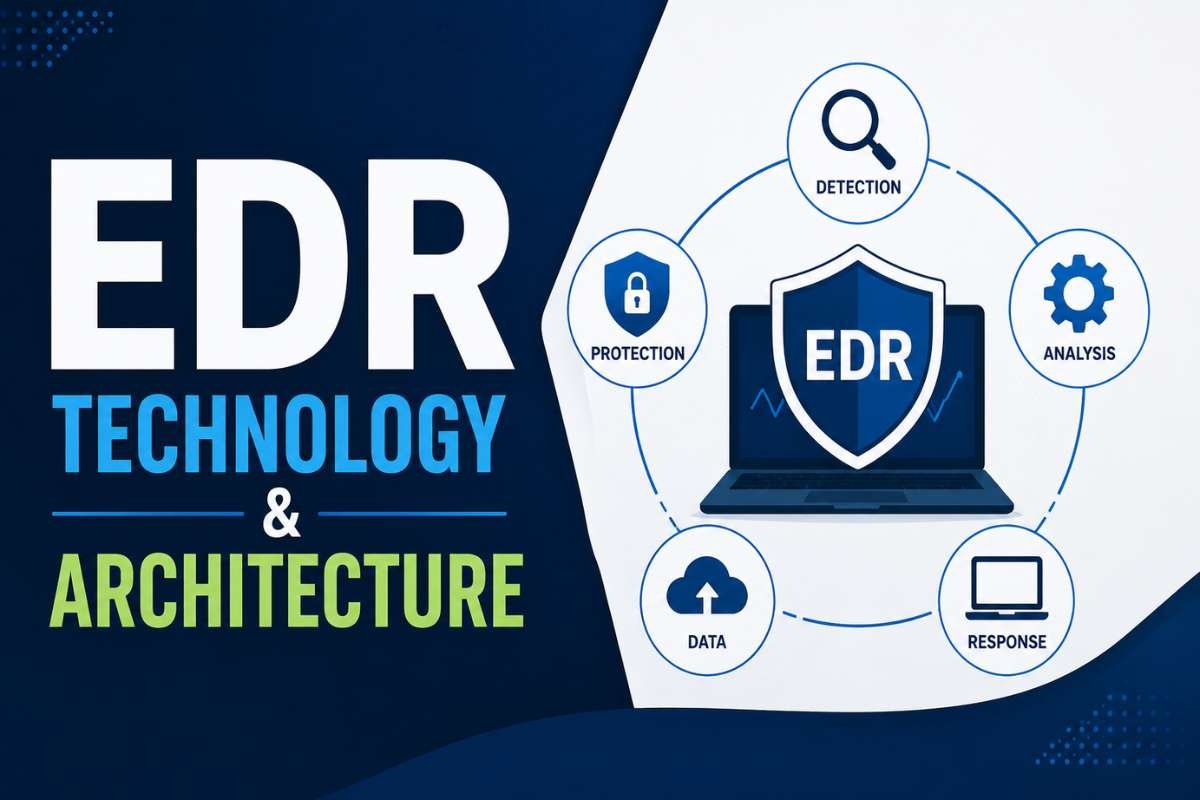
EDR Technology & Architecture covers the technical structure that helps EDR collect endpoint activity, process and store security data, detect suspicious behavior, investigate threats, and support response.
Most EDR platforms include an endpoint agent, data collection and storage, detection tools, investigation features, and response controls. How these parts work together affects visibility, detection, performance, scalability, and the workload for security teams.
This article focuses on those architectural building blocks and how they fit together.
What is EDR Technology & Architecture?
EDR technology is the set of tools and capabilities used to monitor endpoints, detect suspicious activity, investigate threats, and support response. EDR architecture describes how these tools and components work together.
The architecture usually has several connected layers:
Endpoint agent → telemetry collection → processing and storage → detection → investigation → response
The endpoint agent collects security-related information from the device. The platform then processes that data so detection rules and analysis tools can identify activity that may need attention.
This structure matters because an EDR platform is more than software installed on a laptop. It is a connected system that depends on reliable data collection, analysis, communication, and response.
What Are the Core Layers of an EDR Technology & Architecture?
A typical EDR architecture has six connected layers. Each layer handles a different part of collecting, analyzing, and responding to endpoint activity.
| Architecture layer | Primary role | Typical function |
| Endpoint | Capture activity | Agent and endpoint sensors |
| Collection | Gather data | Security events and endpoint telemetry |
| Processing | Organize data | Parsing, enrichment, and correlation |
| Detection | Find threats | Rules, behavior analysis, and threat intelligence |
| Investigation | Add context | Search, timelines, and event relationships |
| Response | Contain threats | Isolation, process termination, and remediation |
Endpoint:
The agent and sensors collect security-related activity from the device, such as processes, files, and network connections.
Collection:
This layer gathers the data from endpoints and sends it to the EDR platform for analysis.
Processing:
The platform organizes and enriches the data so it can be searched, compared, and connected with other events.
Detection:
Detection tools examine the data for signs of suspicious or harmful activity using rules, behavior analysis, and threat intelligence.
Investigation:
Security teams can search the collected data, review timelines, and connect related events to understand what happened.
Response:
Response controls allow teams to contain a threat by actions such as isolating an endpoint, stopping a process, or removing a threat.
The key is that these layers depend on each other. Detection needs useful endpoint data, investigation needs enough context, and response needs a reliable connection to the affected device.
The architecture is therefore a chain of dependencies. A weakness in one layer can reduce the value of the layers above it.
How Does the EDR Agent Collect Endpoint Telemetry?

The EDR agent runs directly on an endpoint and collects security-related activity. It then sends this information to the EDR platform for analysis.
Depending on the device and operating system, the agent can collect information about running processes, file changes, network connections, user activity, commands and scripts, system events, applications, and device settings.
NIST notes that endpoint security software can also collect information about an endpoint’s operating system, applications, accounts, firmware, and runtime environment.
The amount of data collected matters. Too little telemetry can leave gaps during an investigation, while too much can increase storage, processing, and management needs. Agent design is therefore a balance between visibility and system overhead.
The operating system also affects how telemetry is collected. EDR platforms may use different sensors or collection methods for Windows, Linux, and macOS. For example, Microsoft documents an eBPF-based sensor for its Linux endpoint protection, showing how endpoint security technology can use different methods depending on the operating system.
Where is EDR Data Stored and Processed?
Once the EDR agent collects endpoint data, the platform needs to process and store it so security teams can use it for detection and investigation.
Raw endpoint events are not always useful on their own. The platform may organize the data, add context, make it searchable, and connect related events. It may also keep the data so analysts can review past activity.
The data can be processed and stored in different ways. A cloud-based EDR sends endpoint data to a central cloud service. An on-premises EDR keeps more of the system within the organization’s environment. A hybrid setup uses both local and cloud resources.
CISA’s EDR guidance allows endpoint event data to be stored outside the endpoint, including in on-premises or cloud storage, and supports integration with SIEM platforms.
Storage design also affects security operations. It determines how much historical data analysts can review, how quickly they can search it, and how long the organization can retain it. That makes data storage an important part of EDR architecture, not just an infrastructure choice.
How Does the EDR Detection Engine Analyze Endpoint Data?
The detection layer uses endpoint telemetry to find activity that may indicate a threat.
It can look at detection rules, known indicators, behavior patterns, threat intelligence, and links between events. For example, a command-line process may not be suspicious on its own. But if it starts from an unusual process, connects to a suspicious network address, and runs on a sensitive device, the combined activity may indicate an attack.
EDR platforms can run automatic searches as well as searches initiated by security teams. These searches can use endpoint data such as operating system details, process activity, network connections, executable files, and directory information to identify suspicious behavior.
The difference is simple. Telemetry is the data EDR collects, while detection is how the platform uses that data to identify threats.
A strong EDR architecture therefore needs both good endpoint visibility and reliable detection methods.
What Makes EDR Investigation Architecture Useful to Security Teams?

The investigation layer helps security teams connect separate events and understand what happened during an incident.
Instead of looking at a suspicious process, file change, or network connection on its own, analysts can see how different events are linked. They can trace the users, files, devices, and connections involved and understand what happened before and after an alert.
This helps answer basic questions such as which process started the activity, which user was involved, what files or systems were affected, and whether similar activity appeared on other endpoints.
EDR platforms can also let analysts search endpoint data, alerts, forensic information, device details, and activity within specific time periods. These capabilities are important because the activity that explains an alert may have started days before the alert appeared.
Good investigation architecture connects events across time and shows how they relate to each other. This gives analysts the context they need to understand how endpoint detection and response works across monitoring, detection, investigation, and response.
How Do EDR Response Controls Connect to the Architecture?
The response layer allows security teams to act after EDR identifies suspicious activity. Depending on the platform, it may let teams isolate a device, stop a process, quarantine a file, or block certain activity.
These actions depend on a reliable connection between the EDR platform and the endpoint. Finding a threat is only useful if the system can also act on it.
EDR platforms can also automate some response actions, such as isolating an endpoint or stopping a process. However, organizations need clear rules for when these actions should happen automatically and when a security analyst should approve them. A closer look at automated incident response explains how these actions can be handled with less manual work.
For example, automatically isolating a device may help contain a serious threat, but doing so for every alert could disrupt normal business activity. The architecture therefore needs to support both technical response controls and clear response policies.
What EDR Deployment Models Should Organizations Consider?
Organizations can deploy EDR in different ways. The right option depends on their infrastructure, security needs, data policies, and how their security team works.
| Deployment model | Best suited for | Key consideration |
| Cloud-hosted | Remote and distributed environments | Connectivity, data storage, and service dependency |
| On-premises | Environments that need more control | Infrastructure, maintenance, and scalability |
| Hybrid | Organizations with mixed needs | Integration and added complexity |
Cloud-hosted EDR makes it easier to manage endpoints from one place, especially when employees and devices are spread across different locations. It does, however, depend on network connectivity and raises questions about where security data is stored.
On-premises EDR gives organizations more control over their systems and data. The trade-off is that the organization must manage the infrastructure, maintenance, and scaling itself.
Hybrid EDR combines both approaches. It can work well when some systems need to stay on-premises while others can use cloud services. However, connecting and managing both environments can be more complex.
The deployment choice should consider data location, endpoint connectivity, data retention, access controls, scalability, and the workload for the security team. It is not just about where the EDR console is hosted.
How Does EDR Technology & Architecture Connect With Other Security Tools?
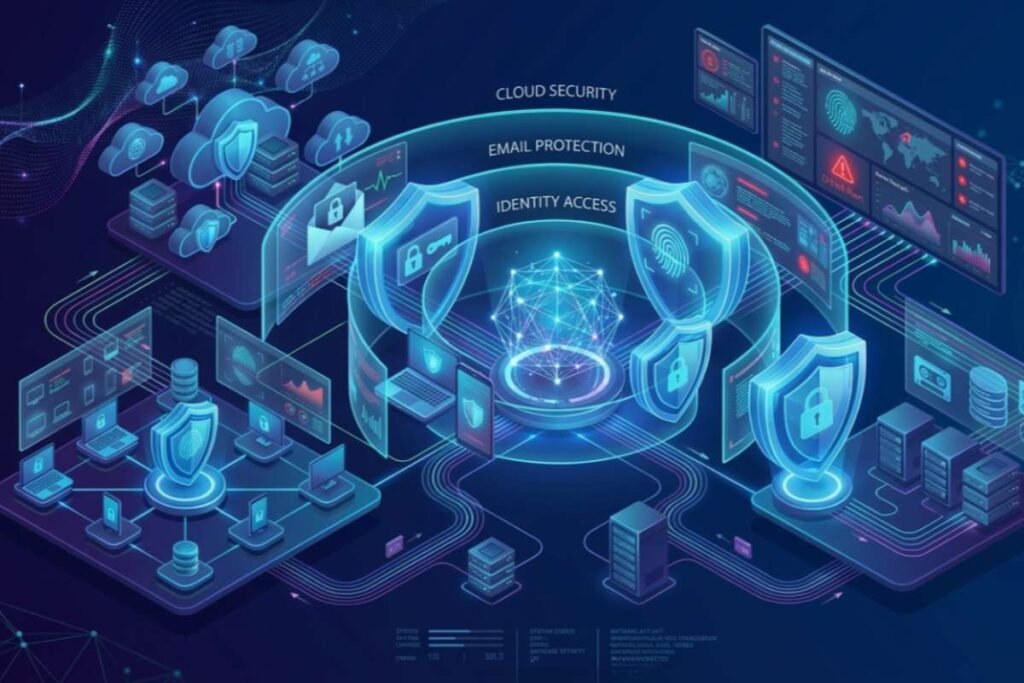
EDR becomes more useful when it shares endpoint data with other security tools. Each connection adds context or helps the team take action.
1. Security Information and Event Management (SIEM):
EDR sends endpoint alerts and event data to the SIEM, where teams can view them alongside logs from networks, servers, and other systems.
2. Security Orchestration, Automation, and Response (SOAR):
EDR sends alerts to SOAR tools, which can trigger set actions such as isolating a device or creating an incident for an analyst.
3. Identity security:
EDR can link device activity to a user or account. This helps teams see whether suspicious activity is tied to a compromised account.
4. Network security:
EDR endpoint data can be compared with network activity to connect what happened on a device with where it communicated.
5. Threat intelligence:
EDR can check files, domains, IP addresses, or other activity against known threat information to add context to an alert.
6. Extended Detection and Response (XDR):
EDR provides endpoint data to XDR, which combines it with signals from email, identity, cloud, and network tools to investigate threats across the environment.
The result is a connected security workflow. EDR provides detailed endpoint data, while other tools add wider context or help automate the response.
Organizations that need this wider view can learn more about Extended Detection and Response
What Should Organizations Look for in EDR Architecture?
Organizations should look at how well an EDR architecture supports detection, investigation, and response, rather than judging it by the number of features it offers.
| Area | What to check? |
| Endpoint coverage | Does it collect useful data from important devices? |
| Telemetry | Does it collect enough data to understand suspicious activity? |
| Detection | Can it spot unusual behavior and known threats? |
| Investigation | Can analysts search data and trace what happened? |
| Response | Can teams quickly isolate or contain affected devices? |
| Integration | Can it work with the security tools already in use? |
| Scalability | Can it support the organization’s number of endpoints? |
| Performance | Does the agent slow down or affect devices? |
| Data management | Can the organization control data storage, retention, and access? |
| Operations | Can the security team manage it effectively? |
A simple way to test an EDR architecture is to follow one security event through the entire system. Can the endpoint capture it? Can the platform process it? Can EDR detect it? Can an analyst investigate it? Can the team respond?
If the process breaks at any stage, the architecture may have a weakness that affects how well EDR works in practice.
What Are the Biggest EDR Architecture Challenges?
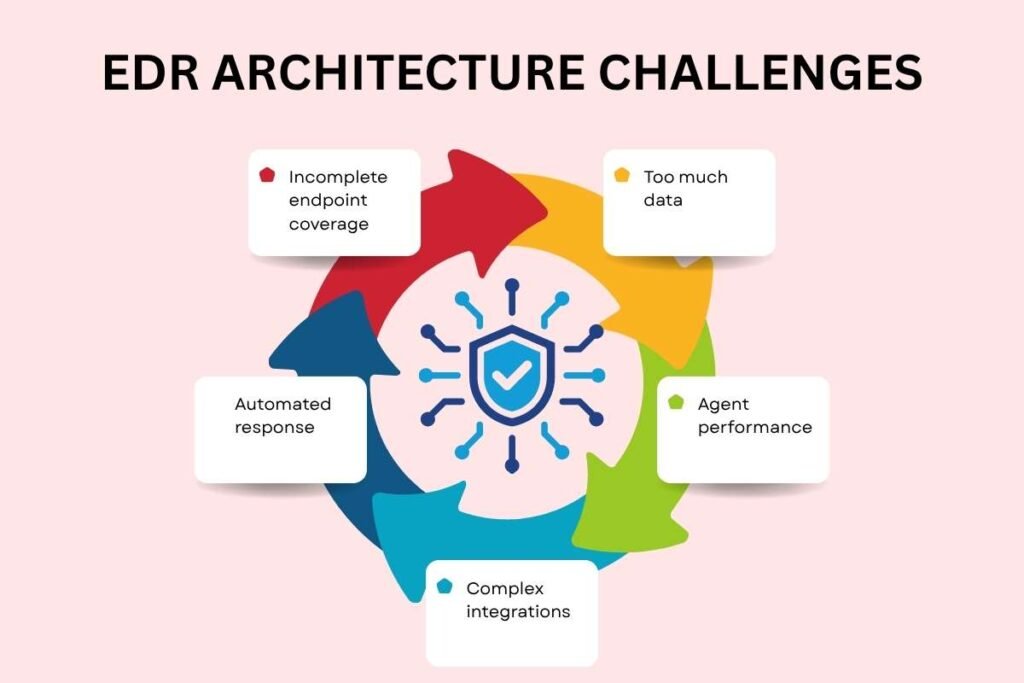
The main EDR architecture challenges often come from balancing security needs with performance and day-to-day management.
- Incomplete endpoint coverage: If important devices do not send data to EDR, security teams may miss threats on those devices.
- Too much data: Collecting more data does not always help. Large amounts of data can make it harder to search, store, and manage.
- Agent performance: The EDR agent runs on business devices, so it should not slow down systems or affect normal work.
- Complex integrations: EDR may need to connect with SIEM, SOAR, identity, network, and other security tools. More connections can mean more work to manage.
- Automated response: Automatic actions such as device isolation can stop threats quickly, but the wrong rule could also interrupt normal business activity.
A strong EDR architecture needs to balance good visibility, fast detection, quick response, device performance, and easy management.
Conclusion
A strong EDR technology & architecture setup connects endpoint data, detection, investigation, and response in one working system. The goal is not to collect the most data or use the most features. It is to build an architecture that gives security teams the right visibility, supports fast action, and works reliably across the organization.
FAQ:
What is the difference between EDR architecture and EDR workflow?
EDR architecture is the technical setup that makes EDR work, including its components and how they connect. The EDR workflow is how those components are used to monitor devices, detect threats, investigate activity, and respond. In simple terms, architecture is how EDR is built, while workflow is how it works.
How does EDR architecture handle large amounts of endpoint data?
It uses data processing, filtering, storage, and search systems to organize endpoint data so security teams can find useful information without handling every event manually.
Does EDR technology & architecture support remote and hybrid workforces?
Yes. Cloud-based EDR can help security teams monitor devices across different locations without requiring them to be connected to the company network.
Can EDR architecture work across different operating systems?
Yes. EDR platforms can support systems such as Windows, macOS, and Linux, although the data collected and available features may differ between operating systems.