A cyber incident can force teams to make critical decisions with limited information. They need to know who takes charge, what happens next, when to escalate, and who needs to be informed.
An Incident Response Plan sets these decisions in advance. It defines roles, escalation paths, communication rules, and response priorities so teams can act without wasting time deciding what to do.
But a plan is only useful if people can use it under pressure. It must be tested, updated, and easy to follow when an incident occurs.
This article covers the key parts of an Incident Response Plan, team responsibilities, incident severity, response steps, communication, testing, and readiness.
What Is an Incident Response Plan?
It is a documented set of processes, responsibilities, and procedures for handling security incidents.
It tells an organization what to do when an incident occurs, who needs to act, and how decisions should be made.
A strong plan usually covers the full response lifecycle. This includes preparation, assessment, containment, remediation, recovery, communication, and post-incident review.
The plan should also define its scope. For example, it may cover ransomware, phishing, unauthorized access, data breaches, malware, denial-of-service attacks, or compromised accounts. The goal is to remove avoidable uncertainty when an incident happens.
Why Does an Organization Need an Incident Response Plan?

When an incident begins, teams may have very little time to decide what happens next. Without clear responsibilities, several people may investigate the same issue while another critical task is ignored. It creates a common process.
It can help teams:
- Establish who has authority to make key decisions.
- Define when an event becomes a confirmed incident.
- Set escalation rules based on business impact.
- Identify who needs to be contacted.
- Coordinate technical and business responses.
- Document decisions and actions.
- Prepare for legal, regulatory, or communication requirements.
- Support recovery after the immediate threat is contained.
NCSC notes that having guidance in place helps organizations make better decisions under the pressure of a real incident and can reveal gaps in their incident-handling capabilities.
A response plan is therefore more about reducing confusion when the pressure is highest.
What Should an Incident Response Plan Include?
The exact structure will vary by organization, but a practical plan should cover the following areas:
| Plan element | What it defines | Why it matters |
| Purpose and scope | Which incidents and systems the plan covers | Sets clear boundaries |
| Roles and responsibilities | Who leads, investigates, approves, and communicates | Prevents confusion |
| Incident definitions | What qualifies as a security incident | Creates a common standard |
| Severity criteria | How incidents are ranked | Helps set response priorities |
| Escalation process | When and how an incident moves to a higher level | Gets the right people involved |
| Communication procedures | Who communicates with employees, leadership, customers, or external parties | Reduces inconsistent messaging |
| Response procedures | Key actions for containment, investigation, and remediation | Guides the response |
| Documentation | What evidence, decisions, and actions should be recorded | Supports review and accountability |
| Recovery responsibilities | Who coordinates the return to normal operations | Helps restore services safely |
| Testing and review | How the plan is exercised and updated | Keeps the plan useful |
Keep the main plan simple and easy to follow. Put detailed technical steps in separate playbooks or runbooks so the main document stays clear.
Who Should Be Part of the Incident Response Team?
Incident response is not only a security team’s responsibility.
The people involved will depend on the organization’s size and the type of incident, but the plan may include:
- Security and IT teams
- An incident response lead
- System and application owners
- Senior management
- Legal and compliance teams
- Communications or public relations
- Human resources
- Cyber insurance contacts
- External incident response providers
- Law enforcement, where appropriate
CISA recommends identifying key people who may be needed during a crisis, while NCSC lists IT, senior management, legal, PR, HR, insurance, and incident response personnel among the important contacts to consider.
The important part is to make clear who leads the response and who has authority to approve major actions. For example, isolating a server may be a technical decision. Taking a revenue-generating system offline may require business leadership.
How Should Security Incidents Be Classified and Escalated?
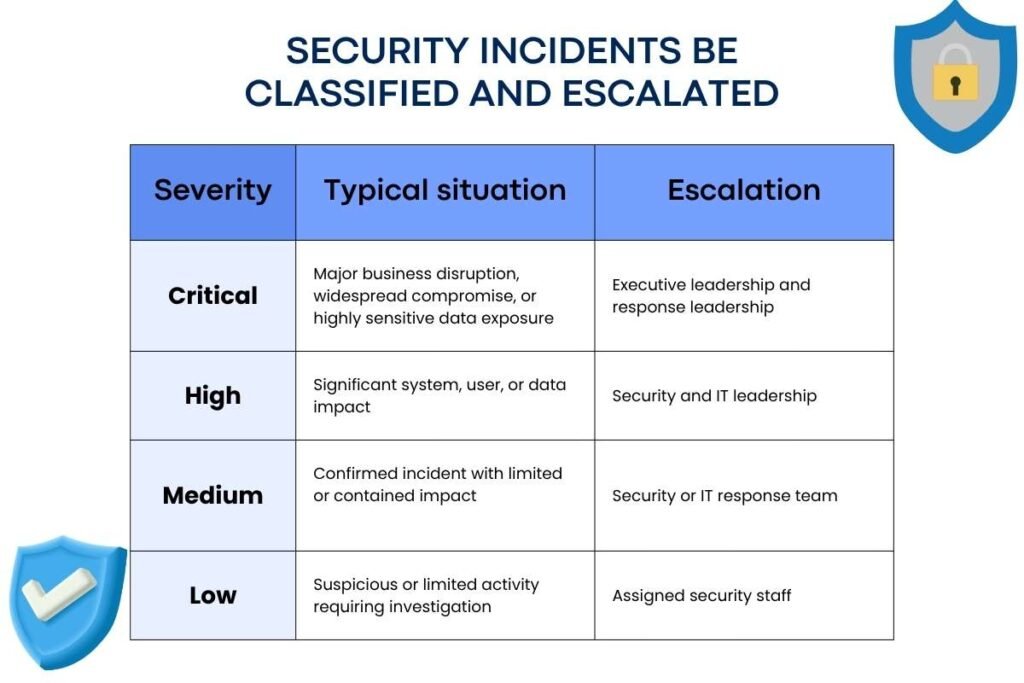
Severity should be based on business impact, affected systems, data involved, attack scope, and the risk of further spread.
For example, an incident affecting one low-risk device may need a different response than an attack involving sensitive data or critical business systems. Teams should also consider whether the incident affects the availability, confidentiality, or integrity of systems and data.
A simple example might look like this:
| Severity | Typical situation | Escalation |
| Critical | Major business disruption, widespread compromise, or highly sensitive data exposure | Executive leadership and response leadership |
| High | Significant system, user, or data impact | Security and IT leadership |
| Medium | Confirmed incident with limited or contained impact | Security or IT response team |
| Low | Suspicious or limited activity requiring investigation | Assigned security staff |
These categories are examples, not a universal standard. Each organization should define thresholds based on its own risk and business operations.
The value of classification is knowing what happens next. A severity level should trigger a clear escalation path rather than simply adding a label to the incident.
How Does an Incident Response Plan Work During an Attack?
It gives teams a clear sequence to follow when an attack is suspected.
For example, a team detects an unusual login. The account was accessed from an unexpected location, and the user’s device shows suspicious activity.
The response may follow this path:
Assess → Declare → Classify → Escalate → Contain → Investigate → Remediate → Recover → Review
What happens at each stage?
- Assess: Check the alert and gather enough information to confirm whether an incident has occurred.
- Declare: Formally treat the event as a security incident and start the response process.
- Classify: Determine the severity based on the systems, data, and business impact involved.
- Escalate: Bring in the right security, IT, legal, or business teams based on the severity.
- Contain: Limit the damage by actions such as isolating a device, disabling an account, or blocking malicious traffic.
- Investigate: Examine available evidence to understand what happened, how it happened, and what else may be affected.
- Remediate: Remove the cause of the incident and fix the security weakness that allowed it to happen.
- Recover: Restore affected systems and return to normal operations.
- Review: Record what happened, what worked, and what needs to change.
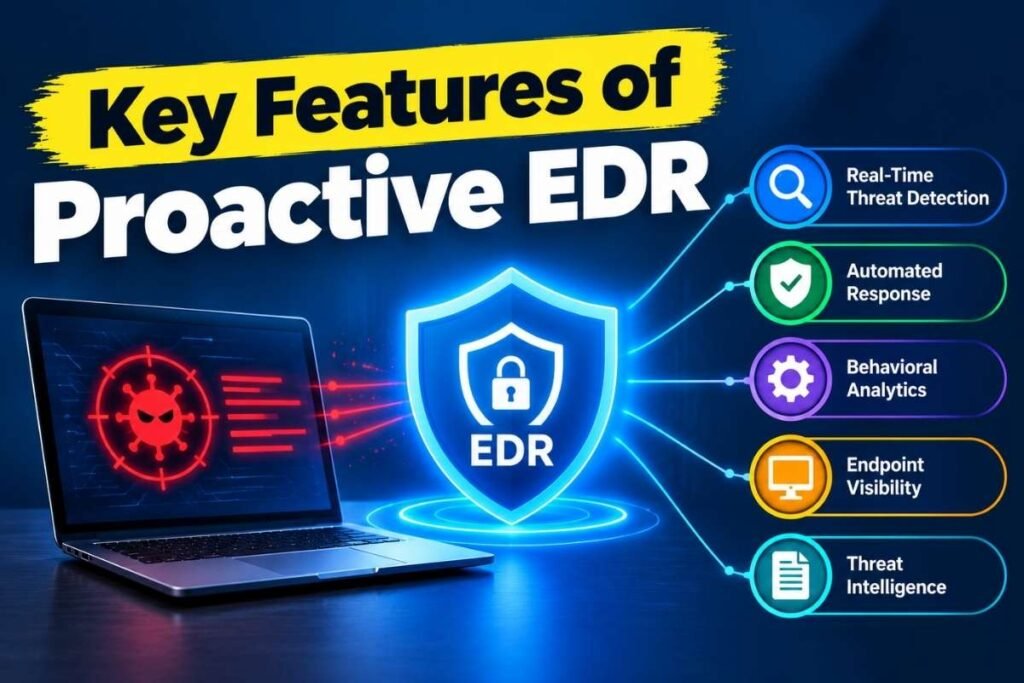
During an investigation, Endpoint Detection and Response can provide useful evidence from affected devices, such as processes, files, accounts, and other activity.
The process may not always move in a straight line. New evidence can send the team back to investigation or containment before it can move forward.
What is the Difference Between an Incident Response Plan, Playbook, and Runbook?
An Incident Response Plan sets the overall response. It defines who is involved, when to escalate an incident, how teams communicate, and what the response should achieve.
A playbook focuses on a specific type of incident, such as ransomware or a phishing attack. It gives the team clear steps for handling that type of incident.
A runbook goes into the technical details. It explains exactly how to carry out a specific task, such as disabling a user account or isolating a device.
An incident response policy sits above all three. It sets the organization’s rules, responsibilities, and expectations for incident response.
Quick comparison:
| Document | What it does | Detail |
| Incident response policy | Sets rules and responsibilities | High-level |
| Incident response plan | Organizes the overall response | Operational |
| Playbook | Provides steps for a specific incident | Detailed |
| Runbook | Explains how to perform a specific technical task | Highly detailed |
For example, the Incident Response Plan may require a ransomware attack to be escalated to security and business leaders. The ransomware playbook can outline how to identify affected systems, contain the attack, check backups, and start recovery. A runbook can then provide the exact steps an administrator needs to isolate a system or disable an account.
How Should Teams Communicate During a Security Incident?

Communication can become difficult when normal systems are affected or when several teams are working at once.
The plan should therefore establish who communicates what, to whom, and through which channel.
Internal communication may include updates to security, IT, executives, legal teams, and affected business units. External communication may involve customers, partners, regulators, law enforcement, insurers, or the media, depending on the incident.
Teams should also have backup communication methods. If an attacker has compromised corporate email, using the same channel to coordinate the response may create additional risk.
Communication should also be controlled. Not everyone needs every detail, and sensitive information should only be shared with people who need it to perform their role.
How Do You Test an Incident Response Plan?
Testing shows whether the plan works when teams need to act. Use tabletop exercises, technical simulations, communication tests, or scenario-based drills.
A tabletop exercise can start with a scenario such as a compromised employee account accessing a critical application. The team then works through the response without carrying out the technical actions.
Technical exercises test whether teams can isolate systems, preserve evidence, restore services, and use backup communication channels. They should also confirm that the security tools supporting the response provide the required visibility and response controls. EDR Technology & Architecture explains how these capabilities are built and how endpoint data supports detection, investigation, and response.
After each test, check whether roles were clear, escalation worked, the right people could be reached, and required tools and logs were available. Record any delays, gaps, or conflicting instructions and update the plan.
The Canadian Centre for Cyber Security recommends testing, revisiting, and revising the plan annually, while Microsoft recommends regular testing against serious attack scenarios.
How Can You Measure Incident Response Readiness?
Response metrics can show how efficiently a team handles incidents, but speed alone does not tell the whole story.
| Metric | What it measures | What it can reveal |
| Mean Time to Acknowledge (MTTA) | Time taken to recognize and acknowledge an incident | Alert handling and initial response |
| Mean Time to Detect (MTTD) | Time between malicious activity and detection | Detection capability |
| Mean Time to Contain | Time needed to limit the incident | Containment efficiency |
| Mean Time to Remediate (MTTR) | Time needed to resolve the incident | Overall response and recovery |
| Exercise completion rate | How often planned tests are completed | Preparedness discipline |
| Escalation accuracy | Whether incidents reach the right people | Decision and communication quality |
Readiness should also consider decision quality, role clarity, evidence availability, communication, and the ability to carry out the plan under pressure.
Frequently Asked Questions
1. What should an Incident Response Plan include for a small business?
A small business should at least define key contacts, incident types, escalation rules, communication methods, response priorities, backup procedures, and recovery responsibilities. The plan does not need to be lengthy to be useful.
2. How often should an Incident Response Plan be tested?
Organizations should test the plan regularly and after major changes or incidents.
3. Who is responsible for maintaining an Incident Response Plan?
Security or IT leadership will often coordinate the plan, but maintenance should involve the people responsible for business operations, legal matters, communications, and affected systems.
4. Can an Incident Response Plan reduce the impact of ransomware?
Yes, a well-tested plan can help an organization make faster containment, communication, and recovery decisions during a ransomware incident. It cannot prevent ransomware on its own, but it can reduce confusion and improve coordination when an attack occurs.