A security team may know that something is wrong on an employee’s laptop without knowing how the activity started, what it touched, or whether the threat has spread.
Here, Endpoint Detection and Response (EDR) helps answer these questions by monitoring endpoint activity, detecting suspicious behavior, and providing data for investigation and response.
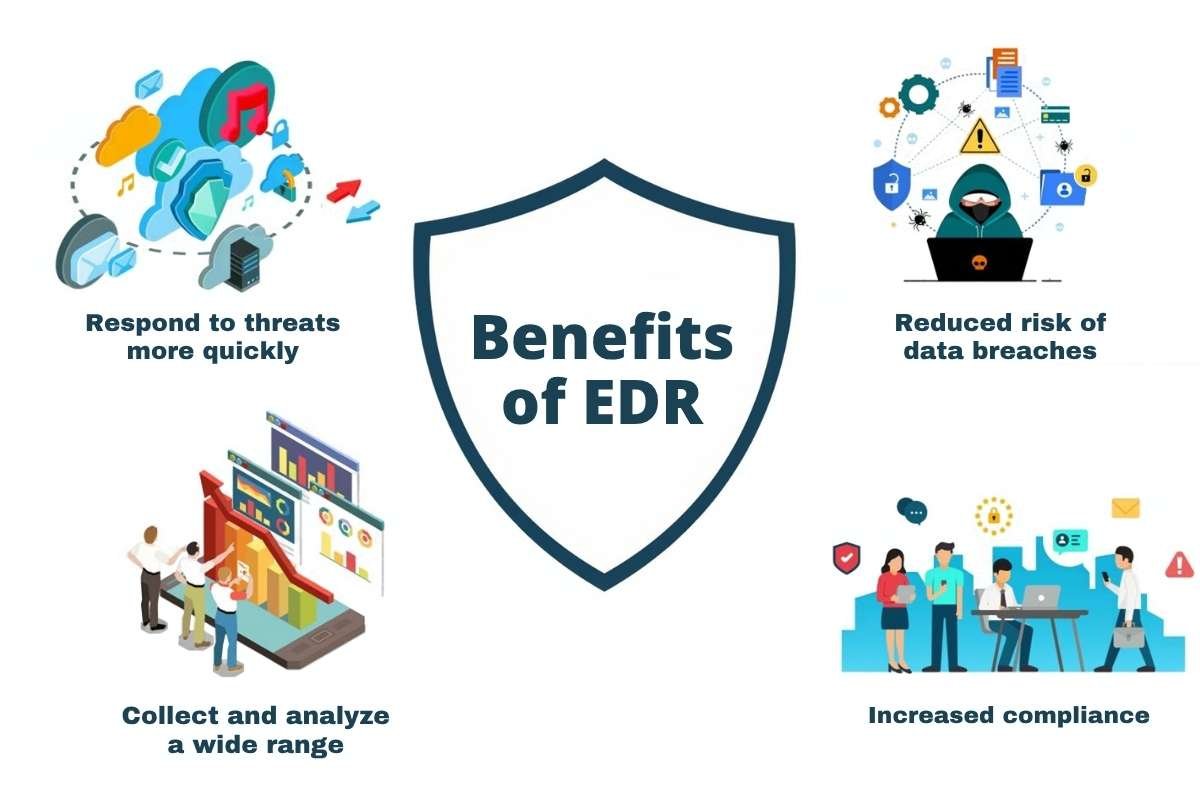
The benefits of Endpoint Detection and Response include better visibility, faster detection, quicker investigations, faster containment, and stronger threat hunting. But the value depends on how well the technology is deployed, monitored, and used.
What Are the Main Benefits of Endpoint Detection and Response?
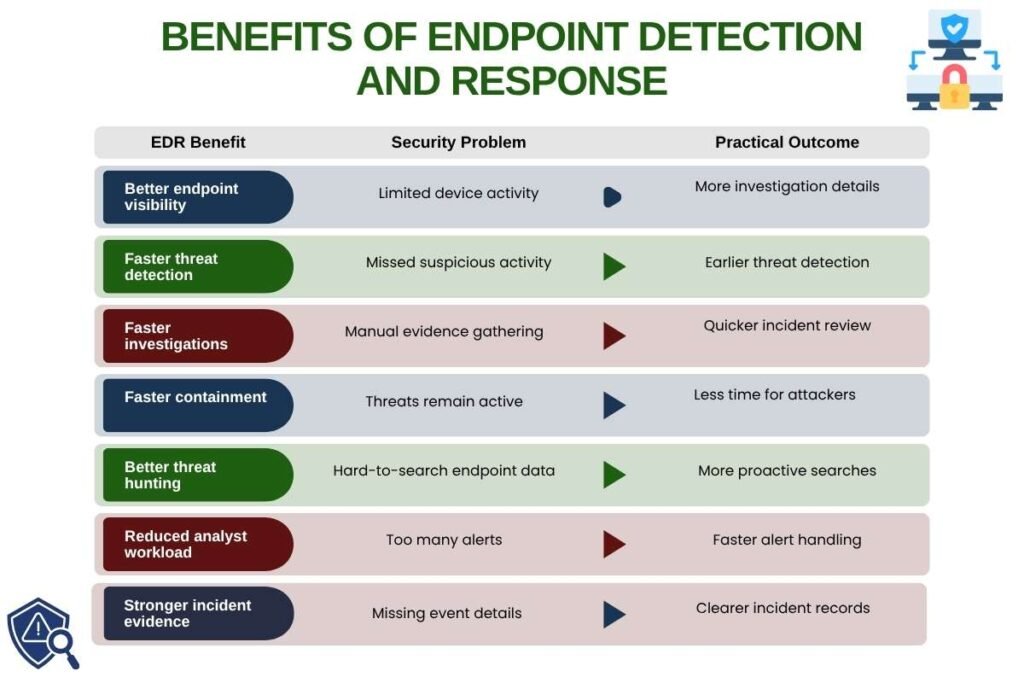
EDR can improve several parts of security operations. The table below gives a quick view of the main benefits and the problems they address.
| EDR Benefit | Security Problem | Practical Outcome |
| Better endpoint visibility | Limited device activity | More investigation details |
| Faster threat detection | Missed suspicious activity | Earlier threat detection |
| Faster investigations | Manual evidence gathering | Quicker incident review |
| Faster containment | Threats remain active | Less time for attackers |
| Better threat hunting | Hard-to-search endpoint data | More proactive searches |
| Reduced analyst workload | Too many alerts | Faster alert handling |
| Stronger incident evidence | Missing event details | Clearer incident records |
These benefits are connected. Better telemetry supports better detection, better detection supports faster investigation, and better investigation can lead to faster response.
The sections below look at what each benefit means in practice.
How Does EDR Help Teams See Endpoint Activity?
An endpoint can generate a large amount of activity during normal work. Users open files, run applications, connect to websites, change settings, and access business systems every day.
The problem is that attackers can use many of the same functions.
EDR continuously records selected endpoint activity and gives security teams a way to examine it in context. Depending on the platform, this can include processes, files, network connections, user activity, system changes, and process relationships.
This visibility becomes especially useful when several ordinary events occur together.
For example, a user opening a document may be normal. A script starting after the document opens may deserve attention. If that script then downloads a file and connects to an unusual external system, the sequence becomes more important than any single event.
EDR helps connect those events so analysts can see the wider activity on the device.
This is also where the underlying EDR Architecture matters. The way an agent collects, processes, stores, and exposes telemetry affects how useful that data becomes during detection and investigation.
How Can EDR Help Detect Threats Faster?

Speed matters when malicious activity is already running on a device.
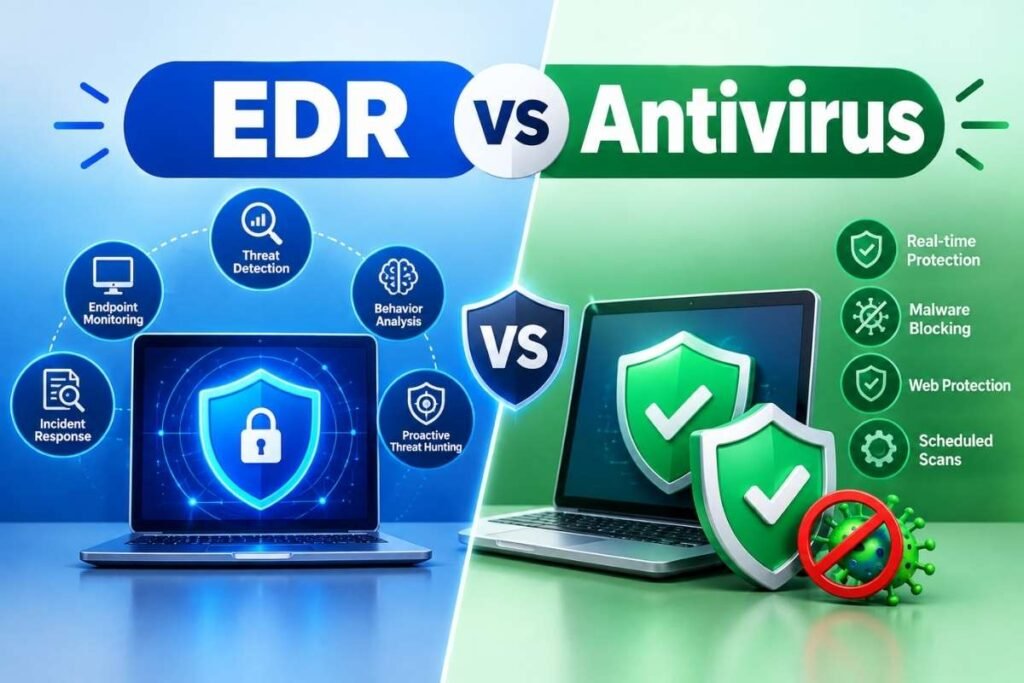
Traditional antivirus remains useful for detecting and blocking known threats, but EDR adds continuous monitoring and behavioral analysis. This allows teams to look for activity that may be suspicious even when there is no simple malicious file to identify.
One of the key benefits of Endpoint Detection and Response is the ability to connect related events instead of treating each alert in isolation.
Consider an endpoint where:
- A document launches an unusual process.
- That process starts PowerShell.
- PowerShell downloads an executable.
- The executable creates another process.
- The device then connects to an unusual host.
The sequence gives analysts more information than any single event.
This matters for attacks that use legitimate system tools. CISA has warned about living-off-the-land techniques, where attackers use tools already available on a system to blend malicious activity with normal administrative behavior.
EDR does not guarantee early detection of every attack. Its benefit is that continuous endpoint monitoring gives security teams more opportunities to identify suspicious behavior while it is happening.
How Does EDR Speed Up Security Investigations?
An alert is only the starting point. Analysts still need to know what happened, which user or process was involved, what changed, and whether the activity spread.
EDR brings related endpoint data together, including process activity, file changes, user accounts, and network connections. This gives analysts a timeline that can help them understand the incident faster.
For example, an analyst may see a document launch an application, the application start a script, and the script download a file that creates a new process. This sequence helps analysts determine what happened and what needs further investigation.
Can EDR Help Contain Threats Before They Spread?
Detection alone does not stop an attacker. Once suspicious activity is confirmed, teams may need to isolate a device, stop a process, quarantine a file, or take another response action. The exact options depend on the EDR platform and its configuration.
The benefit is speed. If a compromised laptop is still connected to the network, an attacker may have more time to move, access accounts, or affect additional systems. Isolating the device can limit that activity while analysts investigate.
However, automation needs clear rules. Automatically isolating every device that triggers an alert could interrupt legitimate business activity.
A high-confidence detection may justify an immediate response. A lower-confidence alert may need analyst review first.
EDR can support containment, but the response should match the confidence, severity, and business impact of the event. This makes EDR one part of a wider Incident Response Plan that covers containment, escalation, recovery, and communication.
How Can EDR Reduce the Workload on Security Analysts?

Security teams can face more alerts than analysts can investigate manually. More data does not automatically mean better security if analysts cannot separate important activity from noise.
EDR can help by adding context around alerts. Instead of showing only that a process ran, an EDR platform may provide information about the user, parent process, child process, file, network connection, and related events. This gives analysts more information when deciding whether an alert deserves attention.
EDR can also automate selected actions. The result is not that analysts become unnecessary. Their time can be focused on decisions that require investigation and judgment.
A security team should not measure success only by how many alerts its EDR platform generates. It should also ask whether analysts can understand and act on those alerts efficiently.
How Does EDR Support Threat Hunting and Forensic Analysis?
Threat hunting looks beyond active alerts. Analysts can search endpoint data for signs of suspicious behavior that may not have triggered a high-confidence detection.
This can help teams investigate questions such as:
- Has this process appeared on other endpoints?
- Did the same file execute elsewhere?
- Which devices contacted a suspicious host?
- Did an unusual account perform similar actions on multiple systems?
- When did the activity first appear?
MITRE ATT&CK documents endpoint behavior monitoring as a way to identify suspicious process activity, file access, and other actions that may indicate an attack.
EDR data can also support post-incident analysis. Once an incident is contained, analysts can review endpoint activity to understand how the attack began, which systems were affected, and whether similar activity occurred elsewhere.
The quality of this work depends heavily on the data available to the EDR platform. If important endpoints are not reporting or useful events are not being collected, investigators may have gaps in the evidence.
Conclusion
The benefits of Endpoint Detection and Response are tied to one basic need: security teams need enough endpoint context to understand suspicious activity and act on it.
EDR can improve visibility, speed up detection and investigation, support faster containment, reduce manual work, and give threat hunters better evidence. But those benefits depend on reliable endpoint coverage, useful telemetry, sound detection rules, and clear response processes.
Used well, Endpoint Detection and Response gives security teams a clearer view of what is happening on devices when every minute matters.
Frequently Asked Questions
1. Does EDR help with cyber insurance requirements?
It can support security controls that insurers may consider, but requirements vary by insurer, policy, industry, and organization.
2. Can EDR protect unmanaged or personal devices?
Coverage depends on the EDR platform, supported operating systems, device ownership, and whether the organization can deploy and manage the EDR agent.
3. Does EDR work on remote employee devices?
Yes. EDR can monitor covered remote endpoints as long as the agent is installed, active, and able to send telemetry.
4. Can EDR reduce false positives?
EDR can provide more context around alerts, helping analysts distinguish suspicious activity from legitimate behavior.
5. Can EDR help detect insider threats?
Yes. EDR can flag unusual user activity, such as unexpected file access, suspicious processes, or unusual network connections.
6. How does EDR help detect fileless attacks?
EDR monitors processes, scripts, and system activity, helping detect suspicious behavior even when the attack does not use a traditional malicious file.