Zero Trust strengthens security, but implementing it comes with real challenges. This guide explains why organizations struggle with legacy systems, identity management, hybrid work, and tool integration. It also covers practical ways to overcome these issues, the tools that support Zero Trust, key metrics to track success, and what the future of Zero Trust security looks like.
More companies are working through the challenges of Zero Trust Implementation as cyber threats continue to grow. Employees now work from different locations, use cloud apps, and connect from many devices. Because of this, the traditional perimeter-based security model of trusting users inside a network no longer works. Businesses now need to verify every user and device before giving access to important data.
Implementing Zero Trust requires more than deploying a new security platform. It takes careful planning, the right policies, and changes across systems, users, and devices. In this guide, you’ll learn why these challenges happen and the practical steps organizations can take to build a stronger, more secure Zero Trust strategy.
What Is Zero Trust Implementation?

Zero Trust implementation is the process of protecting users, devices, and data by checking every access request before allowing it. It operates on the principle that every access request must be verified continuously, regardless of where it originates. No user or device is trusted automatically, even if it is inside the company network.
Many businesses run into challenges with Zero Trust Implementation because they think buying a single security platform is enough. In reality, Zero Trust is an operating model rather than a standalone security product.
Its key parts include:
- Identity verification – verifies every user before granting access.
- Least privilege access – limits permissions to only what’s necessary.
- Device security – checks the security of each device before allowing access to company resources.
- Continuous monitoring – watches users and devices in real time to detect suspicious activity quickly.
Together, these help reduce security risks while giving users only the access they need.
Why Is Zero Trust So Difficult to Implement?
The challenges of Zero Trust Implementation usually begin because organizations must secure systems that were never built for Zero Trust. Most businesses already use older software, cloud platforms, remote work tools, and hundreds or even thousands of connected devices. Bringing all of these together under one security model takes planning and time.
What makes it difficult?
- Legacy systems may not support modern security controls.
- Multiple cloud platforms can have different access rules.
- Hybrid work means users connect from many locations.
- Too many users and devices make access harder to manage.
- Disconnected security tools create gaps that attackers can exploit.
According to the Microsoft Digital Defense Report 2025, identity-based attacks remain one of the fastest-growing cyber threats. This highlights why organizations are moving toward stronger identity-first security.
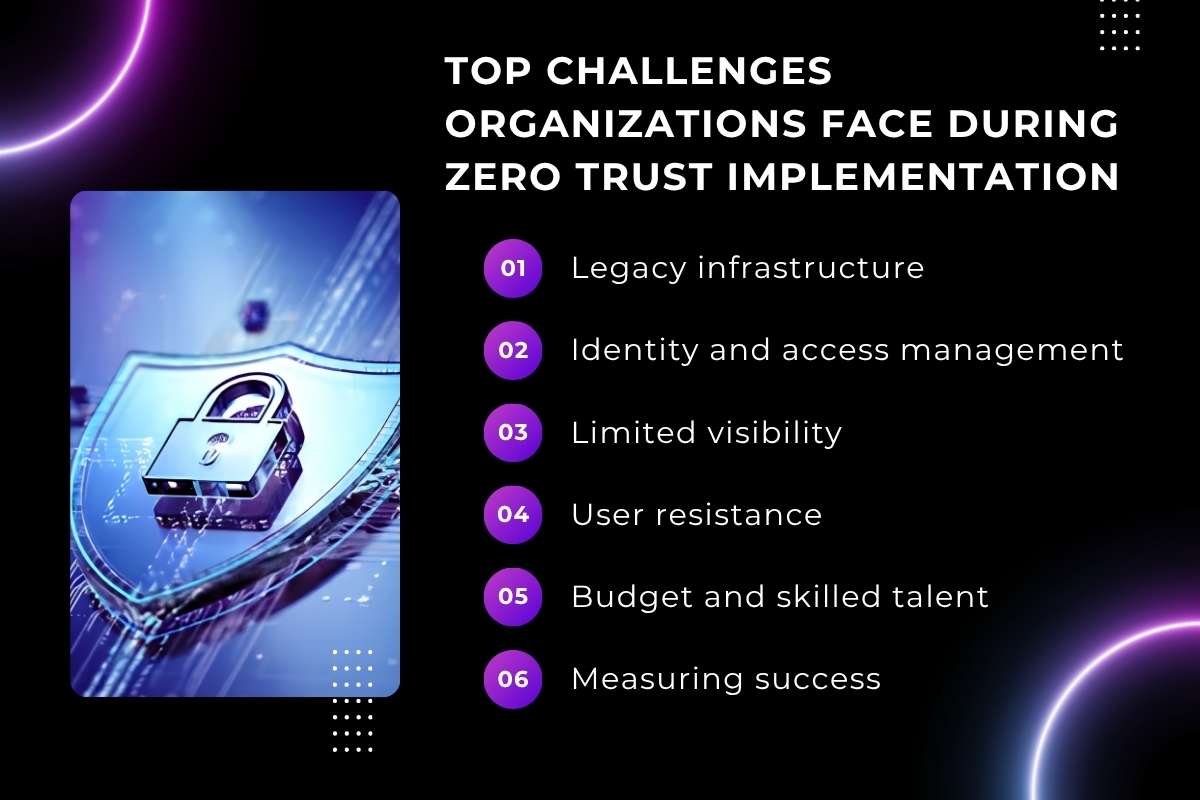
Top Challenges Organizations Face During Zero Trust Implementation
1. Legacy infrastructure
Many organizations still rely on older systems that were not built for modern security. These systems may not support strong identity checks or detailed access controls. Upgrading or replacing them can take time, making Zero Trust harder to roll out.
2. Identity and access management
Managing who gets access is one of the biggest hurdles. Employees change roles, join new teams, or leave the company. Without regular reviews, users often keep access to resources they no longer need, a problem known as privilege creep.
3. Limited visibility
You cannot protect what you cannot see. Many organizations struggle to track personal devices, shadow IT, and third-party apps. These hidden assets create security gaps and make it harder to apply the same access rules everywhere.
4. User resistance
New security steps can frustrate employees. More MFA prompts, stricter login rules, and changes to daily workflows may slow people down at first. Clear communication and training help users understand why these changes matter.
5. Budget and skilled talent
Zero Trust is not a one-time purchase. Organizations need time, trained security teams, and the right tools to keep improving their security. For many businesses, limited budgets and hiring challenges can slow progress.
6. Measuring success
Many teams focus only on deployment and forget to measure results. Useful KPIs include MFA adoption, unauthorized access attempts blocked, Mean Time to Detect (MTTD), and Mean Time to Respond (MTTR). Tracking these metrics shows whether security is improving or if changes are needed.
The benefits of getting it right are clear. IBM’s Cost of a Data Breach Report 2025 found that organizations with mature security practices reduce breach costs compared with less mature environments. Understanding these metrics also helps organizations overcome the challenges of Zero Trust Implementation with better planning and smarter decisions.
How to Overcome These Challenges
The challenges of Zero Trust Implementation are easier to handle when you take one step at a time. Instead of trying to secure the whole organization at once, focus on the areas with the highest risk first. This approach reduces disruption and makes it easier to fix problems before expanding further.
| Action | How It Helps |
| Start with identity first | Secure high-risk users and important business apps before moving to the rest of the organization. |
| Roll out in phases | Start with one team or system, learn from the results, then expand step by step. |
| Map critical assets | List your most important data, systems, and devices so you know what to protect first. |
| Train employees | Teach users why changes like MFA are needed. Good training improves adoption and reduces confusion. |
| Track security metrics | Check metrics like MFA adoption, blocked access attempts, MTTD, and MTTR every quarter to measure progress. |
Following this step-by-step approach helps organizations strengthen security while keeping daily work running smoothly.
Tools That Make Zero Trust Easier
The right tools can make Zero Trust easier to manage, but no single tool can do everything. The challenges of Zero Trust Implementation are easier to solve when these tools work together instead of running separately.
- Identity and Access Management (IAM): Controls who can access systems and data.
- Multi-Factor Authentication (MFA): Adds an extra step to verify users.
- Endpoint Detection and Response (EDR): Monitors devices and responds to threats.
- Zero Trust Network Access (ZTNA): Gives users secure access only to approved applications.
- Security Information and Event Management (SIEM): Collects and analyzes security events from across the organization.
According to Gartner, identity-first security and Zero Trust approaches will continue replacing traditional perimeter-based security as organizations modernize remote access. Integration between these tools is more important than buying the most expensive solution.
What Does the Future of Zero Trust Look Like?

Zero Trust will continue to evolve as cyber threats become more advanced. Organizations are already adopting AI-assisted threat detection, passwordless authentication, continuous verification, and more automation to improve security while reducing manual work. Many are also choosing fewer security vendors so their tools work better together.
In the future, success will not be measured only by the number of attacks blocked. Organizations will also look at business resilience, faster recovery, and a better user experience. These changes will help address the challenges of Zero Trust Implementation while making security simpler to manage.
Conclusion
Zero Trust implementation is a journey, not a one-time project. Every organization will face challenges, especially when managing older systems, cloud platforms, remote users, and growing security needs. The important thing is to start with your biggest risks, make steady progress, and avoid trying to change everything at once.
Over time, regular reviews and small improvements can make a big difference. Measuring results, updating security policies, and training employees will help strengthen your strategy as your business grows. With the right approach, the challenges of Zero Trust Implementation become much easier to manage while building stronger, long-term security.
FAQs
1. Is Zero Trust implementation expensive?
Costs vary, but a phased rollout helps organizations spread investments over time and reduce upfront expenses.
2. Does Zero Trust replace traditional firewalls?
No. Zero Trust works alongside firewalls by adding identity and access controls for every connection.
3. Can Zero Trust improve compliance?
Yes. It helps enforce access controls and supports compliance with many security and data protection standards.
4. What industries benefit most from Zero Trust?
Healthcare, finance, government, retail, manufacturing, and technology organizations benefit from stronger access security.
5. What is the first step in a Zero Trust implementation?
Identify your critical users, applications, and data before applying Zero Trust security controls.