Zero Trust Network Access (ZTNA) helps organizations secure access to applications by verifying users and devices before access is granted. This article explains how ZTNA works, its key benefits, architecture models, and common use cases. It also explores how ZTNA supports remote work, fits into SASE, and helps organizations prepare for future security challenges in cloud and hybrid environments.
Work is no longer limited to the office. Employees use cloud apps, work from different locations, and often access company resources on personal devices. Businesses also need to provide secure access to vendors, partners, and contractors.
Traditional VPNs were not designed for this level of flexibility. They can grant users broad network access after login, which may increase security risks if an account is compromised.
Zero Trust Network Access offers a different approach. It verifies users and devices before granting access to specific applications and resources.
In this article, you’ll learn how ZTNA works, its key architecture models, benefits, use cases, and its role in the future of cybersecurity.
Why Traditional Network Security is No Longer Enough?
For many years, companies used a security model often called a “castle and moat.” The network was the castle, and security tools acted as the moat around it. Once users logged in, they were often trusted and allowed to move across the network.
This approach worked when most employees worked in one office. Today, people use cloud apps, work remotely, and connect from many devices and locations. As a result, the network edge is no longer clear.
VPNs help users connect securely, but they can still provide broad access to internal resources. If an attacker gains access to a VPN account, they may be able to move between systems and search for valuable data. This is known as lateral movement.
The cost of these risks is growing. According to IBM’s Cost of a Data Breach Report 2025, the average global data breach cost reached $4.4 million, the highest level recorded.
| Traditional Security | Modern Security Needs |
| Trust after login | Verify every request |
| Broad network access | App-specific access |
| VPN-based | Identity-based |
| Static controls | Continuous checks |
These changes have led many organizations to adopt Zero Trust Network Access.
The Basics of ZTNA
ZTNA is a security approach that verifies every user and device before allowing access to specific applications, regardless of where the user is located.
ZTNA stands for Zero Trust Network Access. It follows a simple principle of Zero Trust Security: never trust, always verify. Before granting access, it checks the user’s identity, device security, and permissions. Unlike traditional security models that often provide broad network access after login, ZTNA limits users to only the applications they need. This least-privilege approach reduces security risks and helps prevent attackers from moving across company systems if an account is compromised.
The Building Blocks of ZTNA Security

Zero Trust Network Access works by checking users and devices before allowing access to an application. Instead of trusting someone because they are inside the network, every access request is verified.
The process usually follows these steps:
- User requests access to an application or resource.
- Identity verification confirms who the user is through login credentials, multi-factor authentication, or other checks.
- Device security check reviews whether the device meets security requirements, such as having updated software or security tools installed.
- Policy evaluation determines if the user should be allowed access based on company rules.
- Secure connection is established only to the approved application.
- Continuous monitoring begins while the session remains active.
How Does ZTNA Monitor Active Sessions?
ZTNA continues to monitor the session in real time. It may perform session monitoring to watch for unusual behavior, such as a user trying to access unexpected resources.
Some solutions also use risk scoring. If user activity becomes suspicious, the risk score increases, and extra checks may be triggered.
Regular device posture checks help ensure the device remains secure throughout the session. If security settings change, access can be limited or removed.
Through dynamic policy enforcement, permissions can be adjusted instantly based on user behavior, device health, or location changes. This helps organizations respond to risks as they happen rather than after an incident occurs.
The Three Core ZTNA Models
Organizations can deploy ZTNA in different ways based on their users, devices, and security needs. The three most common models are agent-based, agentless, and hybrid.
1. Agent-Based ZTNA
This model requires software, often called an agent, to be installed on user devices. The agent helps collect information about device health, security settings, and user activity. Because it provides deeper visibility into endpoints, organizations gain better control over access decisions. Agent-based ZTNA is often used for full-time employees who regularly access company resources.
2. Agentless ZTNA
Agentless ZTNA does not require software installation. Users typically connect through a web browser to access approved applications. This makes deployment faster and simpler, especially for external users. It is a common choice for contractors, vendors, and partners who need temporary access.
3. Hybrid ZTNA
A hybrid model combines both approaches. Employees may use agent-based access for stronger security, while contractors use agentless access for convenience. This gives organizations more flexibility without creating a one-size-fits-all system.
Which ZTNA Model Is Right for Your Organization?
| Scenario | Best Choice |
| Employees | Agent-based |
| Contractors | Agentless |
| Mixed workforce | Hybrid |
The right model depends on security requirements, user types, and operational needs. Many organizations implement Zero Trust Network Access through a hybrid approach to balance security, visibility, and ease of access.
Benefits of ZTNA
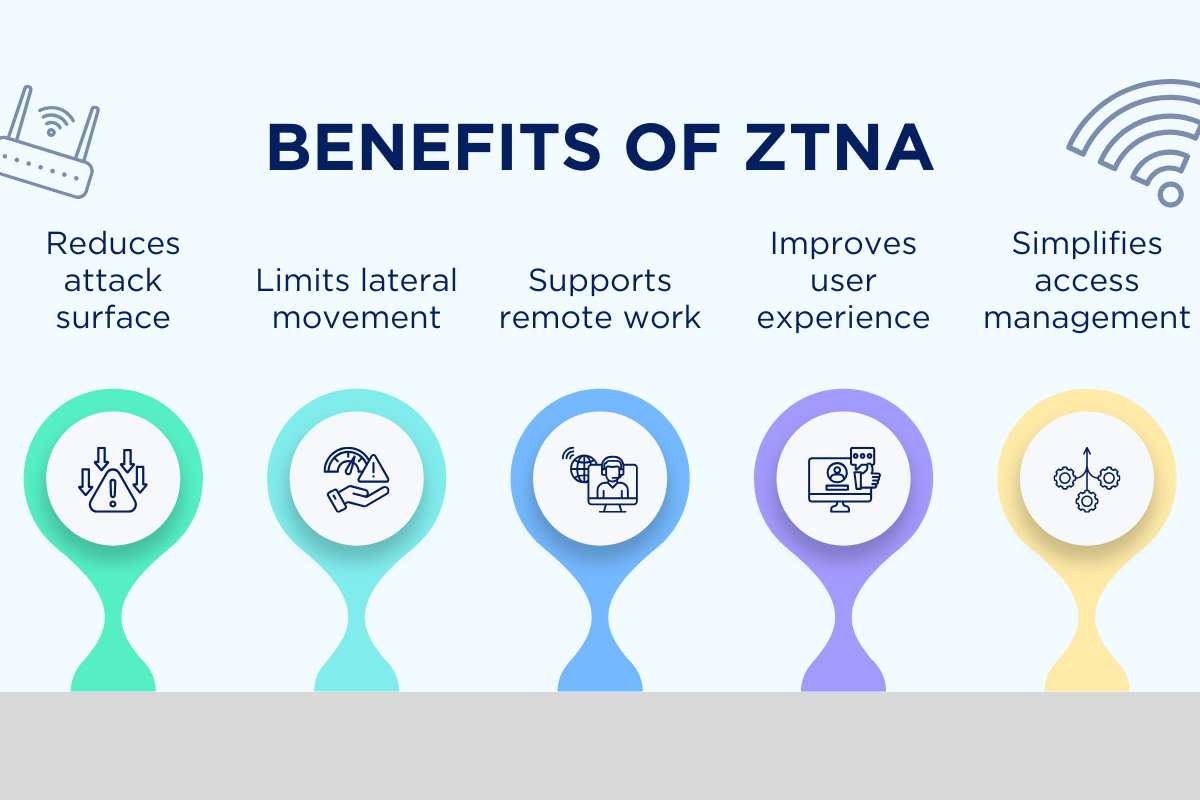
Modern organizations need security that protects data without slowing people down. ZTNA helps achieve this by controlling access at the application level rather than the network level. This approach provides several security and operational benefits.
- Reduces attack surface: Users can access only approved applications, which limits exposure to sensitive systems.
- Limits lateral movement: If an account is compromised, attackers cannot easily move across the network to reach other resources.
- Supports remote work: Employees can securely access applications from any location without depending on traditional network boundaries.
- Improves user experience: Users connect directly to the applications they need instead of navigating a full corporate network.
- Simplifies access management: Security teams can apply access policies based on identity, device health, and user roles.
Identity-first security is becoming more important every year. According to Microsoft’s Digital Defense Report 2025, in the first half of 2025, identity-based attacks rose by 32%. As attackers increasingly target user accounts and credentials, organizations need stronger ways to verify who is requesting access. Rather than trusting users after a single login, Zero Trust Network Access continuously validates identities and access requests before granting access to applications.
Together, these benefits help organizations strengthen security, support flexible work environments, and manage access more effectively as their technology environments grow.
ZTNA and SASE: How They Work Together
What Is SASE?
SASE, short for Secure Access Service Edge, is a cloud-based framework that combines networking and security services into a single solution. Instead of managing separate tools for connectivity, security, and access control, organizations can bring them together under one architecture. This helps support remote users, cloud applications, and distributed workplaces more effectively.
One area that often confuses is the relationship between ZTNA and SASE. While they are closely connected, they are not the same thing.
| Feature | ZTNA | SASE |
| Primary purpose | Secure application access | Secure and optimize network access |
| Scope | Access control | Networking and security framework |
| Focus | Users, devices, and applications | Users, devices, applications, and traffic |
| Network access | Limited to approved applications | Covers a broader network and security services |
| Security approach | Identity-based access | Multiple security layers working together |
| Components | Single technology | Collection of technologies |
| Includes ZTNA | No | Yes |
| Typical use case | Controlling access to applications | Managing secure connectivity across an organization |
How ZTNA Fits Inside SASE

ZTNA is often one of the technologies that make up a SASE architecture. It handles application access by verifying users and devices before allowing connections. Other SASE components may manage web security, network traffic, cloud security, and connectivity between locations.
The key takeaway is that ZTNA and SASE are not competing solutions. ZTNA solves a specific access control challenge, while SASE provides a broader framework that can include ZTNA alongside other security and networking services. For many organizations, ZTNA becomes an important building block within a larger SASE strategy.
Use Cases for ZTNA
Organizations use ZTNA to secure access across a wide range of business scenarios. Rather than giving users broad network access, it connects them only to the applications they need. This makes it useful for both everyday operations and more complex business situations.
| Use Case | How ZTNA Helps |
| Remote employee access | Allows employees to securely access applications from any location without exposing the full network. |
| Third-party vendor access | Restricts vendors and partners to only the systems required for their work. |
| Cloud application protection | Controls access to cloud applications based on user identity, device status, and security policies. |
| Multi-cloud environments | Applies consistent access controls across applications hosted on different cloud platforms. |
| Mergers and acquisitions | Enables controlled access between organizations while systems and security policies are being integrated. |
| Temporary workforce access | Provides short-term access for seasonal workers, consultants, and project-based teams, with permissions that can be removed when work is complete. |
Many of these scenarios involve users working outside traditional office environments. Zero Trust Network Access helps organizations maintain security without creating unnecessary barriers for employees, partners, or contractors.
As businesses continue to adopt cloud services, remote work models, and flexible staffing, the ability to control access at the application level becomes increasingly important. These use cases show how ZTNA supports both security and operational efficiency in modern workplaces.
Also Read: How Zero Trust Architecture Reduces Cyber Risks in Organizations
ZTNA as a Core Component of Future Tech

The way organizations secure access is continuing to evolve. As cloud adoption grows and work becomes more distributed, security models must adapt to new technologies and new risks.
Several trends are shaping the future of access security:
- AI-driven security decisions that can respond to risks faster
- Identity-first security strategies
- Cloud-native applications and infrastructure
- Edge computing environments
- Hybrid work models that support users from anywhere
Another important trend is the rise of machine identity. Most discussions focus on verifying human users, but modern environments also contain APIs, applications, service accounts, and workloads that communicate with each other automatically. These digital identities can become security risks if they are not properly verified and controlled.
This shift is already underway. According to CyberArk’s 2025 State of Machine Identity Security Report, 50% of organizations reported security breaches linked to compromised machine identities.
Future security strategies will increasingly need to validate both people and machines before granting access. As organizations expand their cloud environments and adopt more automated systems, Zero Trust Network Access will play an important role in securing interactions between users, devices, applications, and machine identities.
Conclusion
Traditional security was built for a time when most employees worked inside an office network. Today, people work from different locations and use cloud applications every day.
ZTNA helps meet these new security needs by verifying users and devices before granting access to applications. This helps reduce risk and limits unauthorized access.
As organizations adopt frameworks like SASE, Zero Trust Network Access is becoming an important part of modern cybersecurity. Its focus on secure, identity-based access makes it well-suited for the future of work.
FAQs
1. What is Zero Trust Network Access?
Zero Trust Network Access verifies users and devices before granting access to specific applications, following a least-privilege approach.
2. Is ZTNA replacing VPNs?
Many organizations are replacing or supplementing VPNs with ZTNA for more precise and secure application access.
3. What is the difference between ZTNA and SASE?
ZTNA controls application access. SASE is a broader framework that combines networking and security services, including ZTNA.
4. Who should use ZTNA?
Organizations with remote workers, cloud applications, contractors, or hybrid environments can benefit from ZTNA.
5. Is ZTNA suitable for small businesses?
Yes. ZTNA helps small businesses improve access security without exposing their entire network.