Zero Trust Security Principles help organizations improve security by checking every user and device before granting access. Instead of trusting users automatically, access is verified continuously. Key principles include least-privilege access, ongoing monitoring, and strong identity checks. These practices help reduce cyber risks, protect sensitive data, support remote work, and build stronger security for modern business environments.
The way people work has changed. Employees use cloud applications, work from different locations, and connect through many devices. Businesses also give access to vendors, partners, and contractors. This has made traditional security models less effective.
Cybercriminals are also targeting identities more often than networks. According to the Microsoft Digital Defense Report 2025, identity-based cyberattacks increased by 32% during the first half of 2025. As a result, many organizations are adopting Zero Trust Security Principles, which follow a simple rule: never trust, always verify.
In this guide, you’ll learn how these principles work, why they matter, and how organizations can use them to strengthen security.
What Are Zero Trust Security Principles?
Zero Trust is a security approach that assumes no user or device should be trusted automatically. The concept was popularized by security analyst John Kindervag in 2010. Instead of trusting someone after they log in, every access request must be verified.
This is the main difference between traditional and Zero Trust security. Traditional models focus on who is inside the network. Zero Trust checks identities, devices, applications, and network activity before allowing access.
Zero Trust Security Principles are not a product that organizations can buy. They are a security framework that guides how access decisions are made across systems, users, and data.
| Traditional Security | Zero Trust Security |
| Trust after login | Continuous verification |
| Broad access | Least-privilege access |
| Network-focused | Identity and data-focused |
| Internal trust assumed | No implicit trust |
The Core Principles of Zero Trust Security

Most cybersecurity frameworks are built on a few key rules. The same is true for Zero Trust Security Principles, which focus on reducing trust and improving verification.
1. Verify Explicitly
Every access request should be checked before access is granted. This includes verifying user identities, device health, and other details such as location or login behavior. Many organizations also use multi-factor authentication (MFA) to add an extra layer of security.
2. Least-Privilege Access
Users should only get the access they need to do their jobs. This helps reduce risk if an account is compromised. Organizations often use role-based access controls and just-in-time access to limit unnecessary permissions.
3. Assume Breach
Zero Trust works on the idea that attackers may already be inside the environment. Because of this, organizations continuously monitor activity and separate systems to prevent threats from moving freely between resources.
4. Continuous Validation
Trust is not permanent. Access should be checked throughout a session, not only during login. If risk levels change, access can be limited or removed.
Why Is Continuous Validation Becoming More Important?
Many people think security checks end after login. Modern Principles of Zero Trust Security go further. They can reevaluate access when a device becomes risky, a user changes location, or unusual activity is detected. This helps organizations respond faster to potential threats.
Mapping Zero Trust Principles to Technologies
Security principles become effective when they are supported by the right tools. Organizations use different technologies to put Zero Trust Security Principles into practice across users, devices, applications, and data.
| Principle | Supporting Technologies |
| Verify Explicitly | MFA, Identity Providers, Device Trust |
| Least Privilege | IAM, PAM, RBAC |
| Assume Breach | EDR, XDR, SIEM |
| Continuous Validation | Risk-Based Authentication |
| Data Protection | Encryption, DLP |
For example, MFA helps verify user identities, while IAM and PAM tools control who can access specific resources. EDR and XDR solutions help detect suspicious activity, and encryption protects sensitive data.
The adoption of these technologies continues to grow. Gartner predicts that 70% of new remote access deployments will rely primarily on Zero Trust Network Access (ZTNA) by 2027.
Technology helps enforce Zero Trust Security Principles, but tools alone are not enough. Strong policies, clear access rules, and continuous oversight are equally important.
Implementing Zero Trust Principles Step-by-Step
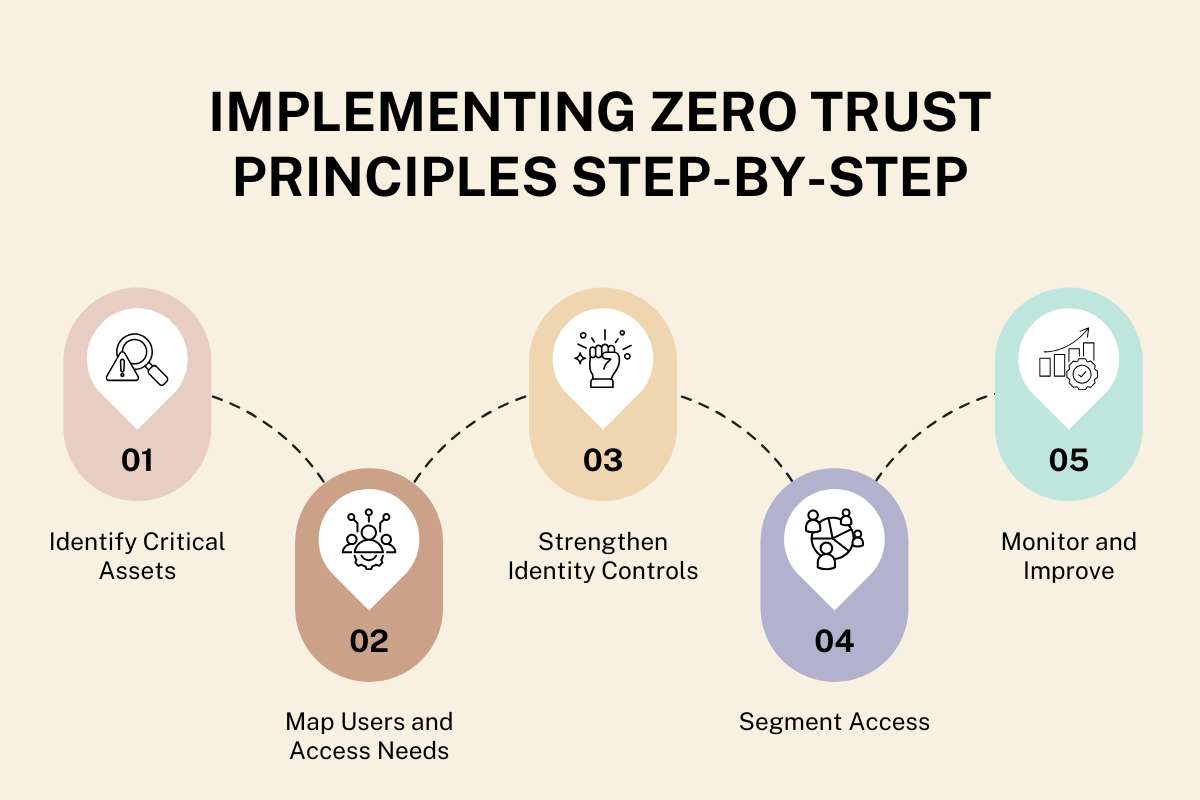
Adopting Zero Trust does not require replacing every security tool at once. Most organizations can start by following a clear, structured process.
Step 1: Identify Critical Assets
Begin by identifying the resources that need the most protection. This includes business applications, sensitive data, and critical systems that support daily operations.
Step 2: Map Users and Access Needs
Next, determine who needs access to what. Review access requirements for employees, contractors, vendors, and other users. This helps ensure people only receive the permissions they actually need.
Step 3: Strengthen Identity Controls
Implement MFA, strong authentication methods, and identity governance policies. These controls help verify users before access is granted.
Step 4: Segment Access
Divide systems into smaller sections and restrict unnecessary connections between them. This limits how far attackers can move if a breach occurs.
Step 5: Monitor and Improve
Review logs, monitor risks, and update policies regularly. Effective Zero Trust Security Principles require ongoing improvement.
Common Implementation Mistake
Many organizations focus on network controls first. A better approach is to map users and access needs before making technical changes. When organizations understand who needs access to specific resources, they can build more effective security policies and avoid unnecessary restrictions.
Benefits of Zero Trust Security Principles
Organizations adopt Zero Trust for a simple reason: it helps reduce security risks while supporting modern ways of working.
1) Reduced Attack Surface
Users only receive the access they need. This creates fewer opportunities for attackers to reach sensitive systems and data.
2) Better Protection for Remote Work
Employees can securely access applications and resources from different locations without relying on broad network access.
3) Improved Compliance
Many security and privacy regulations require stronger access controls, monitoring, and data protection. Zero Trust supports these requirements.
4) Faster Threat Detection
Continuous monitoring helps security teams spot unusual activity sooner and respond before a threat spreads.
The financial impact of cyberattacks remains significant. According to the IBM Cost of a Data Breach Report 2025, the global average cost of a data breach reached $4.4 million.
By following Zero Trust Security Principles, organizations can strengthen security, lower risk, and support business operations without creating unnecessary barriers for users.
The Future of Zero Trust Security Principles

Cybersecurity is becoming less focused on network boundaries and more focused on identities, devices, and data. As organizations adopt more cloud applications, verifying who is requesting access is becoming increasingly important.
New technologies are making security checks faster and more accurate. Passwordless authentication, stronger device trust controls, and smarter risk analysis can help organizations detect potential threats without disrupting users.
The future of Zero Trust Security Principles will center on continuous verification rather than one-time checks. Organizations will increasingly protect identities and sensitive data, ensuring that access remains secure even as users, devices, and work environments change.
Conclusion:
Modern organizations face increasing security challenges due to cloud adoption, remote work, and evolving cyber threats. Traditional security methods are no longer enough to protect sensitive information and business systems. Zero Trust security principles provide a stronger approach by ensuring that every user, device, and application is verified before access is allowed.
By following practices like continuous validation, least-privilege access, and ongoing monitoring, organizations can reduce security risks and prevent unauthorized access. Zero Trust is not just a technology solution but a long-term security strategy that helps businesses build a more secure, flexible, and resilient digital environment.
FAQs
1. What industries benefit most from Zero Trust?
Healthcare, finance, government, and technology organizations often benefit due to sensitive data and strict regulations.
2. Does Zero Trust replace firewalls?
No. Firewalls remain important, but Zero Trust adds verification and access controls beyond network security.
3. How long does Zero Trust implementation take?
Timelines vary. Small projects may take months, while larger organizations often adopt Zero Trust gradually.
4. What is the difference between Zero Trust and VPN security?
VPNs grant network access, while Zero Trust verifies users and limits access to specific resources.