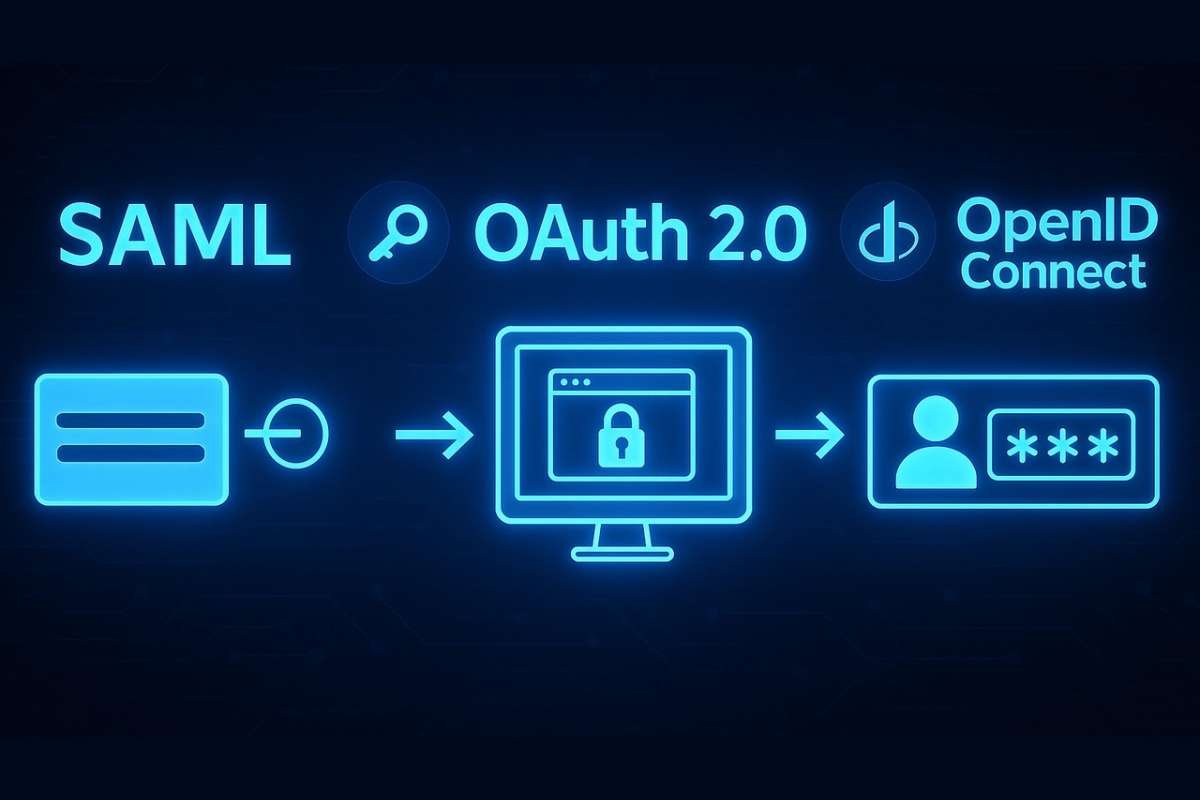
A user needs to sign in. An application needs to access an API. An enterprise wants employees to use the same identity across several services. SAML Federation vs OAuth vs OpenID Connect can enter the conversation in all three cases, but they do not solve the same problem.
Each technology solves a different problem. SAML is widely used for enterprise identity federation, OAuth is built for delegated access to protected resources, and OpenID Connect (OIDC) adds user authentication to OAuth 2.0.
The real question is not which one is best. It is which technology fits the access problem you are trying to solve. Let’s break down where each one fits, how they relate, and when using more than one makes sense.
SAML Federation vs OAuth vs OpenID Connect: What Is the Difference?

The easiest way to understand these three technologies is to start with what each one helps an application do:
- SAML: Lets one system securely share a user’s login information with another system, often for enterprise SSO.
- OAuth 2.0: Lets an application get limited permission to access a protected resource, such as an API or user data.
- OpenID Connect (OIDC): Lets an application confirm who the user is while using OAuth 2.0.
These roles can overlap in a larger identity setup, but the technologies are not interchangeable. SAML is commonly used when organizations need users to sign in to different business applications through a trusted identity system. OAuth focuses on giving an application permission to access something, while OIDC adds user login and identity information to an OAuth-based flow.
| Technology | What it does | Common use | What it uses |
| SAML | Shares trusted login information between systems | Enterprise SSO | SAML assertion |
| OAuth 2.0 | Gives an application limited access to a resource | APIs and third-party apps | Access token |
| OpenID Connect | Confirms who a user is | Web and mobile login | ID token + access token |
A simple way to remember the difference is: SAML helps systems trust a user’s login. OAuth controls what an application can access. OIDC helps an application know who the user is.
What Problem Does Each Technology Solve?
The real difference becomes clearer when you look at the specific access problem each technology is designed to handle.
1. SAML Federation:
SAML becomes useful when two separately managed systems need to trust the same login event. For example, a company can let employees use its existing identity provider to access a third-party SaaS application without creating a separate login for each employee.
The SAML assertion carries information that the receiving application can evaluate, such as who authenticated, where the assertion came from, who it was intended for, and when it is valid. The application can then use those details to create the user’s session and apply the relevant access rules.
This makes SAML a practical fit for:
- Enterprise SSO
- B2B SaaS applications
- Organizations with an existing SAML identity provider
- Environments where a customer’s identity system must work with an external service
2. OAuth 2.0
OAuth is useful when an application needs permission to access something without receiving the user’s password.
OAuth expert Justin Richer explained this clearly in an interview with the Center for Internet Security, describing OAuth as a framework that lets software act on a user’s behalf without exposing the user’s credentials.
Consider a project-management app that needs to read a user’s calendar. The calendar service can issue an access token that represents the permissions granted to the project-management app. The app then uses that token when calling the calendar API. The important detail is that the token represents access, not proof of the user’s identity.
OAuth is therefore a strong fit for:
- Protected API access
- Third-party application integrations
- Access to user-owned data
- Service-to-service access
- Different permission levels through scopes
For example, an API might allow an application to read calendar events but not create or delete them. The exact permissions depend on the resource server and the scopes it supports.
3. OpenID Connect
OpenID Connect becomes useful when an application needs to let a user sign in and verify who that user is using an OAuth-based flow.
OIDC adds this identity function to OAuth 2.0. After authentication, the application receives an ID token containing claims about the user, such as a unique identifier and other approved identity information.
This makes OIDC useful for:
- New web applications
- Mobile applications
- User-facing applications that need modern login
- Systems that also need OAuth-based API access
A key implementation detail is that an ID token and access token have different jobs. The ID token identifies the authenticated user, while the access token is used to access a protected resource.
For a deeper look at SAML-based authentication, see the SAML Authentication.
How Do SAML Federation vs OAuth vs OpenID Connect Work Together?
These three technologies can work in the same application environment, but they usually handle different steps. The easiest way to see the relationship is through a real example.
Imagine an employee using a company’s new project-management application. The company already has an identity provider that manages employee logins.
Step 1: SAML establishes the employee’s login
The employee opens the project-management application. The application redirects the employee to the company’s identity provider, which authenticates them and returns a SAML assertion to the application.
The application checks that assertion and uses it to establish the employee’s session.
Step 2: OIDC can handle login for a newer application
Now imagine the company also has a newer web application built around OAuth 2.0. Instead of using SAML, that application can use OpenID Connect for user login.
The user authenticates through the identity provider, and the application receives an ID token that contains information it can use to confirm the user’s identity.
Step 3: OAuth gives the application access to an API
After the user is signed in, the project-management application may need to access a separate calendar API. This is where OAuth comes in.
The application obtains an access token with the required permissions and uses it to call the protected API.
The full picture can look like this:
Company identity provider
│
├── SAML ──→ Enterprise application
│
└── OIDC ──→ Modern web application
│
└── OAuth ──→ Protected API
This is the important relationship: SAML and OIDC can handle how an application establishes or verifies a user’s identity, while OAuth handles what an application is allowed to access.
That is also why OAuth should not be treated as a standalone user-authentication protocol. OIDC adds the identity layer on top of OAuth 2.0, while OAuth itself focuses on authorization. OWASP makes the same distinction in its current authentication guidance.
So, an organization does not always have to choose just one. SAML, OIDC, and OAuth can each have a separate role in the same identity architecture, depending on the applications and resources involved.
When Should You Use SAML Federation, OAuth, or OpenID Connect?
The next step is deciding which option fits your application and its existing setup.
Choose SAML Federation for Enterprise SSO
SAML is a practical choice when a SaaS or enterprise application needs to support SSO through a customer’s existing identity provider.
Consider SAML when:
- Enterprise customers require SAML SSO.
- The application already depends on SAML.
- Different organizations need to establish trust.
- The application needs user attributes from the identity provider.
Choose OAuth for API and Resource Access
Use OAuth when an application needs controlled access to an API or protected data.
When evaluating an OAuth setup, check:
- Scopes: What can the application access?
- Token lifetime: How long does access remain valid?
- Client type: Is it a web app, mobile app, or backend service?
- Resource server: Which API will accept the token?
Choose OpenID Connect for User Login
Use OIDC when a modern application needs user login and identity information within an OAuth-based setup.
It is a strong fit for:
- Web applications
- Mobile applications
- Consumer-facing applications
- Applications that also need OAuth-based API access
The application should also validate the OIDC ID token and its claims before relying on the identity information.
Quick Decision Guide:
| Main requirement | Consider |
| Enterprise SSO | SAML |
| Protected API access | OAuth |
| Modern user login | OpenID Connect |
| User login + API access | OIDC + OAuth |
| Legacy enterprise + modern applications | SAML + OIDC/OAuth |
How Are the Tokens and Identity Data Different?
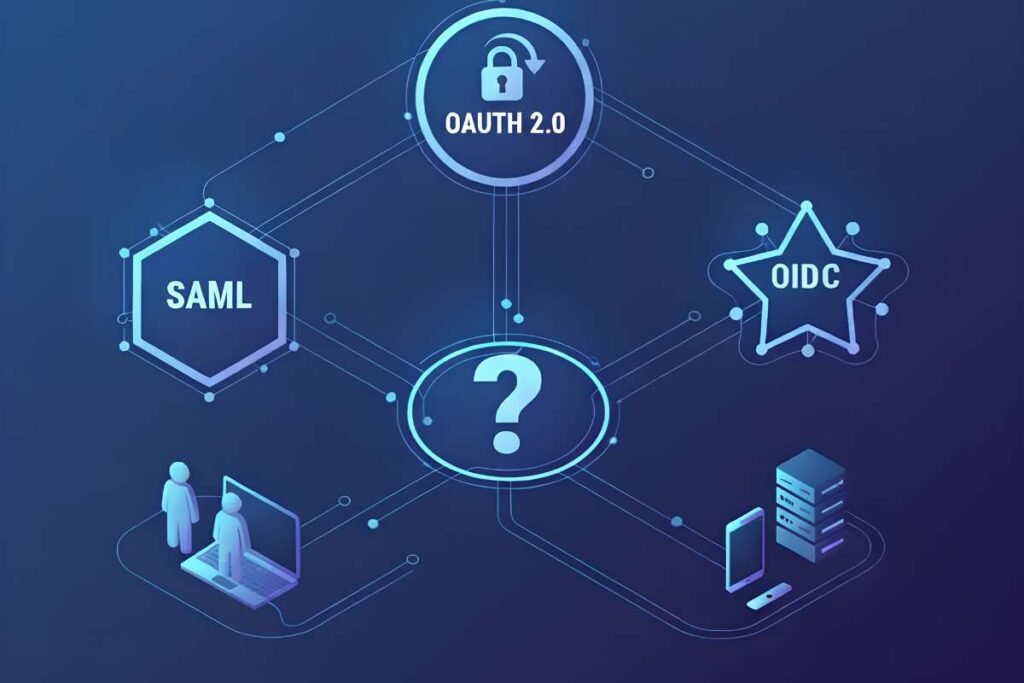
To understand SAML Federation vs OAuth vs OpenID Connect, look at what information each one gives the application and what that information is used for.
1. SAML Assertion:
A SAML assertion is a signed message about a user’s login. It can include details such as who the user is, whether they successfully authenticated, and other approved user attributes. The application checks the assertion before trusting that information.
2. OAuth Access Token:
An OAuth access token is a credential that gives an application permission to access a protected resource.
For example, an application may receive a token that allows it to read calendar data through an API. The token does not, by itself, tell the application who the user is.
3. OIDC ID Token:
An OIDC ID token is a signed set of claims about the user who logged in. The application can validate the token to confirm the user’s identity and use the approved claims.
An ID token is not the same as an OAuth access token. The ID token is about the user; the access token is about access to a resource.
How Secure Are SAML Federation vs OAuth vs OpenID Connect?
Security depends on the protocol, its configuration, and the way it is used. There is no useful rule that says one of these technologies is always “more secure” than the others.
SAML:
A SAML assertion must be checked before the application trusts it. Key checks include the signature, issuer, audience, destination, and expiration. The application should also block replay attacks and XML signature-wrapping attacks.
OAuth:
OAuth security focuses on protecting the authorization flow and access tokens. Exact redirect URLs and PKCE help stop attackers from misusing authorization codes. Access tokens should also have the right permissions and expiration time.
OIDC:
OIDC requires the application to check the ID token before trusting the user’s identity. This includes verifying its issuer, audience, signature, and expiration.
What Are Common Mistakes When Comparing These Technologies?
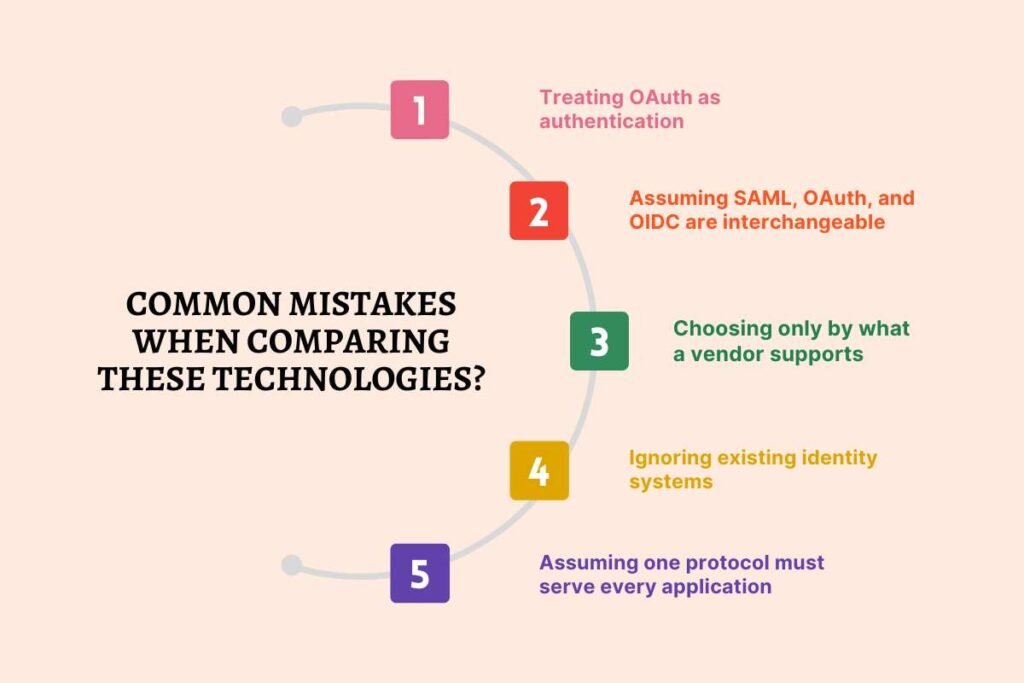
When comparing SAML Federation vs OAuth vs OpenID Connect, a few mistakes appear again and again. Such as:
- Treating OAuth as authentication: OAuth provides authorization. It does not define a standard way for a client to verify the user’s identity. OIDC adds that identity layer.
- Assuming SAML, OAuth, and OIDC are interchangeable: They overlap in some identity architectures, but their main roles differ.
- Choosing only by what a vendor supports: Vendor support matters, but it should not be the first question. Start with the application’s requirements, then check which standards the identity provider, application, APIs, and customers support.
- Ignoring existing identity systems: A new application may be designed around OIDC, but an enterprise customer may already depend on SAML. That does not automatically make either technology wrong. It means the integration needs to account for the existing environment.
- Assuming one protocol must serve every application: Large organizations rarely have identical application environments. A mix of SAML, OAuth, and OIDC can be reasonable when each standard has a clear role.
Conclusion:
SAML Federation vs OAuth vs OpenID Connect is easier to understand when you stop treating the three as direct competitors. SAML, or Security Assertion Markup Language, has a different role from OAuth and OpenID Connect, and some environments may use more than one.
The best choice depends on the application, users, APIs, existing identity systems, and security requirements. Start with what the system needs to protect and what the application needs to know or access. Then choose the technology that fits that job.
FAQs
1. Is SAML Federation better than OpenID Connect for enterprise SSO?
Not always. SAML is a common fit for existing enterprise federation, while OIDC is often considered for newer applications. The right choice depends on the identity environment and application requirements.
2. Can OAuth be used without OpenID Connect?
Yes. OAuth can be used on its own when the goal is authorization, such as giving an application access to a protected API. OIDC is needed when the application also needs a standard way to verify user identity.
3. Should a new mobile app use SAML Federation or OpenID Connect?
OIDC is usually the more relevant starting point for a new mobile login flow because it provides user authentication on top of OAuth. The final choice should also account for the identity provider and application requirements.
4. Why do companies use SAML and OIDC at the same time?
A company may have older enterprise applications that rely on SAML and newer applications that use OIDC. Supporting both can make sense when each serves a different part of the application environment.
5. Can OAuth and OIDC be used together for API access?
Yes. OIDC can handle user authentication, while OAuth access tokens can be used to authorize calls to protected APIs. This is a common way to separate who the user is from what the application can access.