Traditional security builds walls and hopes they hold. Zero Trust assumes they will fail, and plans accordingly. In Zero Trust vs Traditional Network Security, the core shift is from perimeter defense to identity-first access control. This article breaks down exactly how both models handle breaches, insider threats, and remote work, so you can make an informed decision for your setup.
Most companies still run on a simple idea: build a strong wall around your network, and everything inside is safe. That idea worked well when employees sat in offices and data lived in on-site servers. Today, it falls apart.
Remote work, cloud apps, and ransomware have changed the game. Zero Trust vs Traditional Network Security is no longer just a vendor talking point. It is a practical decision that affects how quickly a breach spreads and how much damage it does.
This article breaks down both models clearly. It shows what happens when an insider threat hits each one, and explains why switching to Zero Trust does not mean throwing away your existing tools.
Zero Trust vs Traditional Network Security: What’s the Core Difference?
Traditional network security works on a “castle-and-moat” model. Once you are inside the network (via VPN, office Wi-Fi, or a firewall-approved connection), the system trusts you by default. Access is broad and rarely questioned.
Zero Trust flips that logic. It assumes no user or device is trustworthy by default, even inside the network. Every request must be verified before access is granted. The guiding principle, coined by John Kindervag at Forrester, is simple: “Never trust, always verify.”
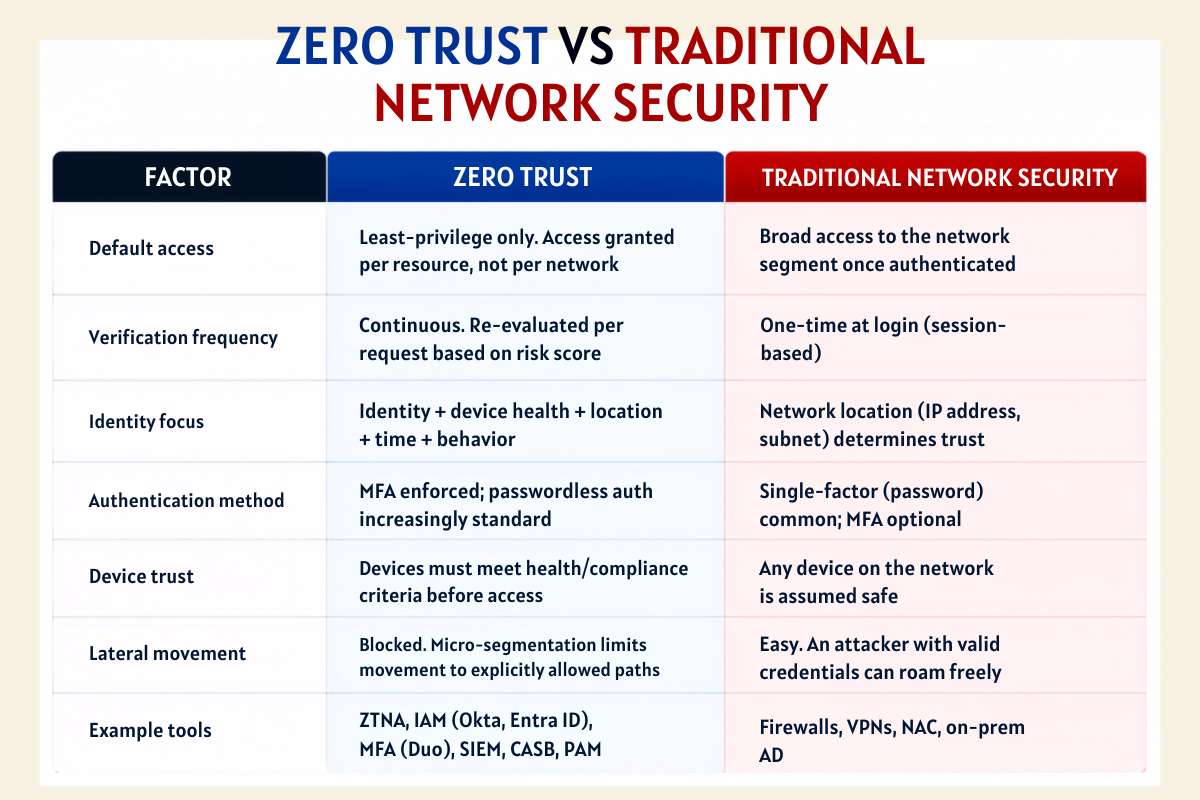
Side-by-Side Comparison:
| Factor | Zero Trust | Traditional Security |
| Default access | Least-privilege only. Access granted per resource, not per network | Broad access to the network segment once authenticated |
| Verification frequency | Continuous. Re-evaluated per request based on risk score | One-time at login (session-based) |
| Identity focus | Identity + device health + location + time + behavior | Network location (IP address, subnet) determines trust |
| Authentication method | MFA enforced; passwordless auth increasingly standard | Single-factor (password) is common; MFA is optional |
| Device trust | Devices must meet health/compliance criteria before access | Any device on the network is assumed safe |
| Lateral movement | Blocked. Micro-segmentation limits movement to explicitly allowed paths | Easy. An attacker with valid credentials can roam freely |
| Example tools | ZTNA, IAM (Okta, Entra ID), MFA (Duo), SIEM, CASB, PAM | Firewalls, VPNs, NAC, on-prem AD |
The table above shows that Zero Trust vs Traditional Network Security is not just a technology difference. It is a fundamental shift in how trust is assigned and to whom.
Other Important Ways the Two Models Differ
1. Cloud and Remote Work:
Traditional security was built for offices and on-prem servers. Cloud apps and remote users sit outside the perimeter it was designed to protect. VPNs patch the gap but create bottlenecks as traffic is routed through a central point. Zero Trust applies the same access policies whether a user is in the office, at home, or on a SaaS app.
2. Insider Threats:
Traditional security has no answer for a valid user doing something they should not. Once credentials are verified at login, the session runs unchecked. This is why insider attacks cost an average of $4.92 million per incident. Zero Trust monitors every user continuously, including employees.
3. Data Protection:
Traditional security protects the boundary around data, not the data itself. If an attacker or insider gets past the perimeter, the data is exposed. Zero Trust enforces policies at the data level. For example, who can access it, from which device, and under what conditions.
4. Blast Radius:
This is the starkest difference. In a traditional model, one compromised account can expose an entire network segment. In Zero Trust, the same compromised account can only reach what it was explicitly permitted to access. The breach still happens. The damage does not spread.
How Do Zero Trust vs Traditional Network Security Compare in Practice?
Neither model is perfect. Traditional security is simpler to deploy and still makes sense in specific situations. Zero Trust wins where those conditions break down.
Traditional security still works when:
- Your entire workforce is on-site with managed devices
- All apps run on on-prem servers inside a defined perimeter
- IT resources are too limited for the identity infrastructure
Zero Trust makes more sense when:
- Employees work remotely or use personal devices
- Your apps are cloud-based or hybrid
- Third parties, like contractors or vendors, access your systems
- You need clean audit trails for compliance frameworks
Quick Verdict by Category
| What matters | Winner |
| Deployment simplicity | Traditional security |
| Upfront cost | Traditional security |
| Breach detection speed | Zero Trust |
| Breach cost reduction | Zero Trust |
| Remote and cloud fit | Zero Trust |
| Compliance reporting | Zero Trust |
Traditional security wins on simplicity and upfront cost. Zero Trust wins on everything that matters when something goes wrong. The real question is not which model is better. It is which one matches the environment you actually operate in?
Breaking the Myth: “Zero Trust Means Rip-and-Replace Your Firewall”

This is one of the most common fears when adopting Zero Trust vs Traditional Network Security. But it is not true. Many IT teams avoid Zero Trust conversations because they assume it means scrapping their existing firewall, VPN, and switch infrastructure.
Reality Check: What You Actually Need to Do
| Myth | Reality |
| Zero Trust replaces firewalls | Firewalls still work. ZT adds identity and context on top |
| You must ditch your VPN immediately | VPNs can coexist; ZTNA replaces VPN function gradually |
| Zero Trust is a product you buy | It is an architecture; you build toward it using existing and new tools |
| It requires a big-bang rollout | Most organizations adopt it in phases over 2 to 4 years |
| SASE means that no trust boundary exists | SASE vendors still enforce trust, just at the cloud edge, not the data center |
How Do You Start Moving to Zero Trust?
You do not need a full infrastructure overhaul to begin. Start here:
- Audit access first. Find over-privileged accounts: who has access to things they never use?
- Enable MFA for every user. Microsoft found MFA blocks 99.9% of automated credential attacks.
- Deploy an Identity Provider (Okta, Azure AD, Google Workspace) to enforce least-privilege access.
- Segment your network so a single compromised account cannot reach everything.
These four steps alone move you meaningfully toward Zero Trust without touching your existing firewall or VPN stack. For a full vendor-neutral roadmap, NIST SP 800-207 is a good choice.
Also read: Identity and Access Management: Components, Working, and Why Most Projects Fail?
Conclusion
Traditional network security was built for a world that no longer exists. Perimeters that made sense earlier leave gaping holes in today’s cloud and remote-first environment.
The core argument in the Zero Trust vs Traditional Network Security debate is not complexity. It is control. Zero Trust gives you finer control over who accesses what, when, and from where. Control is what limits real-world damage when credentials are stolen.
You do not need to tear anything down to get started. Start with identity, enforce MFA, and reduce over-privileged accounts. Those three steps move you meaningfully toward Zero Trust without touching your existing firewall or VPN.
FAQs
1. Is ZTNA better than VPN?
For most modern use cases, yes. ZTNA grants access to specific applications rather than the entire network, which limits exposure if an account is compromised.
2. What is one main reason the Zero Trust model is safer than traditional network security?
Zero Trust limits lateral movement. Even if an attacker gets in with valid credentials, they can only reach the specific resources that the account is permitted to use.
3. Does ZTNA replace the firewall?
No, ZTNA replaces the function of a VPN for remote access. But firewalls still play a role in network segmentation and traffic filtering.
4. How long does a Zero Trust migration take?
Most organizations take 2 to 4 years to fully implement Zero Trust. But meaningful security improvements from identity controls and MFA can be achieved in the first 90 days.
5. Is Zero Trust vs Traditional Network Security a relevant debate for small businesses?
Yes. Small businesses are frequent targets precisely because their defenses rely on perimeter security alone. Even basic Zero Trust steps help reduce that exposure.