Six out of ten data breaches involve a person, not a software flaw, not a network gap. Someone clicked a phishing link, shared a password, or ignored a security prompt. Verizon’s 2025 Data Breach Investigations Report says that 60% of data breaches involve human beings. IBM’s Cost of a Data Breach Report puts the average breach cost at $4.4 million.
This forces security leaders to ask a hard question: if people are the problem, why does most security spending go toward technology?
Human risk management (HRM) answers that. It moves the focus from systems to human actions. It considers that these human actions can be tracked and managed. This guide explains what it is, how it works, its importance, and its benefits.
Defining Human Risk Management
Perspective 1: Cybersecurity
HRM is an approach that uses data to find and reduce security risks caused by humans. These risks include employees clicking phishing links, sharing sensitive data, and more.
Unlike annual compliance training, HRM is continuous. It tracks behavior and assigns risk scores to individuals. Then, it intervenes at the right time where the real risk lies. Not where the calendar says training is due.
Forrester describes it as “a new category of solutions that manage and reduce cybersecurity risks posed by and to humans.”
Gartner defines it as tools that “measure, manage, and influence human cybersecurity risk by tracking and improving user decision-making at scale.”
Perspective 2: HR & People Operations
The same term is used in HR and people operations to refer to managing workforce risks. These include compliance failures, hiring mistakes, and high turnover. A few other risks are employee burnout and reputational damage from workplace disputes.
Both definitions have the same base logic: humans contribute to organizational risks. Understanding human behaviour is essential to handle these risks in both cybersecurity and HR.
This article focuses on the definition of cybersecurity. But for organizations where security and HR teams are working together on risk, the overlap is worth noting.
Key Components of Human Risk Management
A mature HRM program runs on four connected activities.
1. Identify:
Identify specific security details where there are more chances of human risk. Who has access to what? Which roles interact most with external parties? Which individuals have a history of security incidents? Risk signals could come from email behavior, access patterns, or policy adherence logs. The goal is to move from a vague sense that “people are risky” to a data-backed view of where the risk lies.
2. Measure:
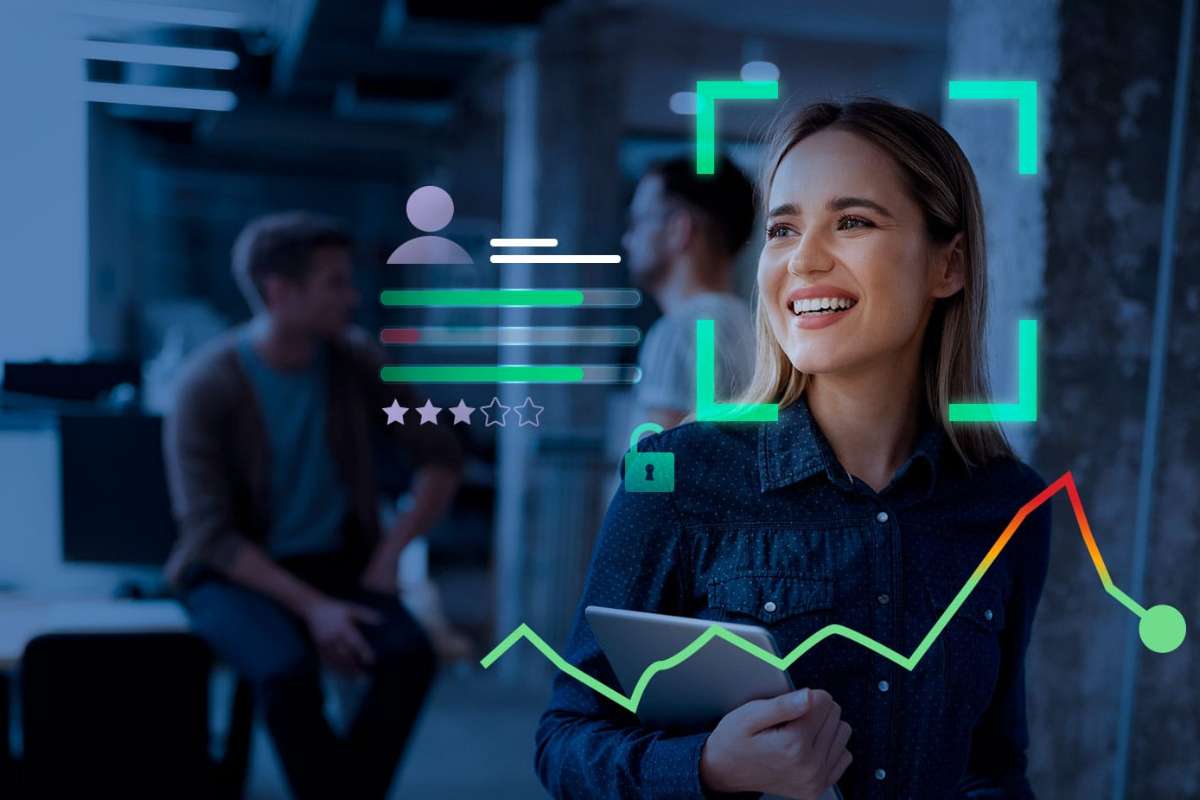
Turn those signals into human risk scores. These scores should be quantified measures of how a person’s current behavior is likely to cause a security incident. Scores are based on factors like phishing-click history, MFA compliance, threat reporting rate, and more. They update continuously, so anyone’s improvement is visible.
3. Intervene:
Target, don’t broadcast. A company running HRM doesn’t send the same training to 500 employees at once. It finds the 40 highest-risk people and provides them with coaching. These people are guided with real-time nudges, microtraining based on specific behavior, and simulated phishing. Interventions work best when they feel supportive, not punitive. If employees fear consequences, they hide risky behavior rather than report it.
4. Improve:
Human risk management is a loop, not a one-off. Scores get updated, and interventions are refined. Outcomes such as a reduction in phishing click rate, an increase in threat reporting, and fewer policy violations are tracked. These are then translated into financial language for board reporting. This connects behavior change to breach cost avoidance.
Real-World Examples
Example 1: Global Consumer Goods Company (Hoxhunt Case Study)
- Background: An FMCG company with 24,000 global employees struggled to manage phishing risk at scale. They used to manually send test phishing emails twice a year and track responses.
- Implementation: They deployed a continuous HRM program. It provided a constant learning environment for employees through automated phishing simulations and feedback.
- Result: There was a decline in phishing email click rate. Failure rate for simulations dropped from 8% to less than 1%. Employees have now started using an integrated reporting button in email instead of informing the service desk.
Example 2: Blackbaud (Living Security Case Study)
- Background: Blackbaud, a cloud software provider, relied on basic compliance checklists for security training. The program gave no clear picture of how employees were actually behaving across different tools.
- Implementation: Blackbaud switched to a platform that connected data from all its security tools in one place. For the first time, the security team could see real employee behavior. And not just training completion rates.
- Result: The results were clear. Blackbaud’s security resilience score nearly doubled. It jumped from 320 to 716, a 124% improvement. Leadership could now see exactly how much safer the organization had become, in plain numbers.
Why is Human Risk Management Important for Cybersecurity?

Technical defenses are only as strong as the humans operating them. A firewall cannot stop an employee from being manipulated into handing over his credentials. A DLP tool cannot prevent an accidental data exposure caused by distraction at 5 PM on a Friday.
Social engineering (manipulating people rather than hacking systems) is the main way hackers break into systems today. AI has made it worse. Attackers now generate personalized phishing emails at scale and clone voices for phone fraud. They even produce deepfake videos impersonating executives. What once took hours to craft now takes seconds.
According to Mimecast’s State of Human Risk 2026 report, most security incidents today are caused by insider threats, credential misuse, and human error. The average cost per insider incident is $13.1 million. Organizations face around six such incidents every month.
Also Read: Why is Data Security Management Central to Enterprise Risk Control in 2026?
Benefits of Human Risk Management
1. Measurable risk reduction:
Track phishing click rates, policy violations, and incidents over time. You get clear before-and-after numbers to show progress.
2. Targeted interventions:
Focus on the 10–15% of employees who create the most risk. Stop sending the same training to everyone and direct resources where they matter.
3. Stronger security culture:
Real-time feedback helps employees build better habits naturally. Over time, this reduces risk without needing constant reminders or enforcement.
4. Board-ready reporting:
HRM turns behavior data into financial terms like breach cost avoided and expected incident reduction. This makes it easier for CISOs to justify security budgets.
5. Regulatory compliance:
HRM supports key regulations, including NIS2, DORA, ISO 27001, and GDPR. It shows regulators that your organization actively manages human risk.
6. Faster threat detection:
When employees feel safe reporting suspicious activity, they quickly report it instead of hiding. Strong HRM programs raise reporting rates across organizations.
Industries Benefiting from Human Risk Management
1) Healthcare:
Patient records are some of the most valuable data attackers can steal. Healthcare workers use email, cloud apps, and third-party portals every day. They work under pressure, which increases the chances of phishing and accidental data exposure. HRM reduces these risks while helping organizations stay HIPAA compliant.
2) Financial services:
Finance employees are common targets for email scams that trick them into approving fake wire transfers. The EU’s DORA regulation now requires financial firms to actively manage human security risks. HRM provides the data and documentation that regulators look for.
3) Professional services and legal:
Law firms and consulting firms handle sensitive client data. Many staff members are non-technical, which makes them easy targets for spear-phishing. HRM solves this with role-specific training. In addition, coaching is based on each team’s risk level.
4) Government and public sector:
Nation-state actors often use social engineering to target government employees. Standard compliance training does not change behavior or build a reporting culture. HRM does both.
5) Technology companies:
Developers often have broad access to cloud systems and sensitive credentials, making them high-value targets. HRM covers the full range of risk, from accidental mistakes like misconfigured storage buckets to insider threats and social engineering attacks.
How AI Is Transforming Human Risk Management
AI is changing HRM on both sides of the equation: as a threat amplifier and as a defense tool.
As a Threat:
AI is used to produce personalized, contextually convincing emails at scale. Voice cloning helps attackers to impersonate executives in real-time phone calls. Deepfake videos are often used for fraud. These attacks are harder to spot and arrive faster than any traditional training cycle can prepare employees for.
As a Defense:
AI makes modern HRM platforms much smarter. Instead of just looking at past mistakes, they use machine learning to analyze daily habits like email behavior and system access. This helps predict and stop human security risks before they happen.
KnowBe4 launched AIDA (Artificial Intelligence Defense Agents) at RSAC 2026. It automates time-consuming HRM tasks like designing phishing simulations and assessing risk. Tasks that used to take hours now take seconds. (KnowBe4 Press Release, March 2026)
The Emerging Frontier:
AI agents as risk subjects. AI agents now operate inside enterprise environments with delegated access and authority similar to humans. They can be manipulated through prompt injection, misused by insiders, or simply make mistakes. Organizations managing human risk in 2026 also need to extend their framework to AI agents.
HRM vs. SAT vs. DLP vs. UEBA: What’s the Difference?
Many organizations already have tools that touch human risk. These include security awareness training (SAT), data loss prevention (DLP), and user and entity behavior analytics (UEBA). HRM is not the same as any of them, though it works alongside all three.
Here’s the difference between all of them:
| Dimension | HRM | SAT | DLP | UEBA |
| Focus | Human behavior change | Security knowledge | Data movement control | Anomalous activity detection |
| Approach | Continuous, behavioral | Periodic, content-based | Policy enforcement | Threat detection via analytics |
| Trigger | Behavioral signal or risk score | Compliance calendar | Policy violation | Anomaly or threshold breach |
| Output | Risk score, behavior change | Completion certificate | Alert, block, audit log | Threat alert, anomaly report |
| Personalization | Individual risk profile | One-size-fits-all | Rule-based | User/entity baseline |
| Goal | Measurable risk reduction | Awareness | Prevent data exfiltration | Detect insider/external threats |
| Owned by | Security + HR (joint) | Security awareness team | Security operations | Security operations |
HRM and UEBA complement each other. UEBA detects anomalous behavior; HRM changes the behavior that causes it. DLP is reactive; HRM is proactive. SAT still has a role, but it is no longer enough on its own.
Challenges in Human Risk Management
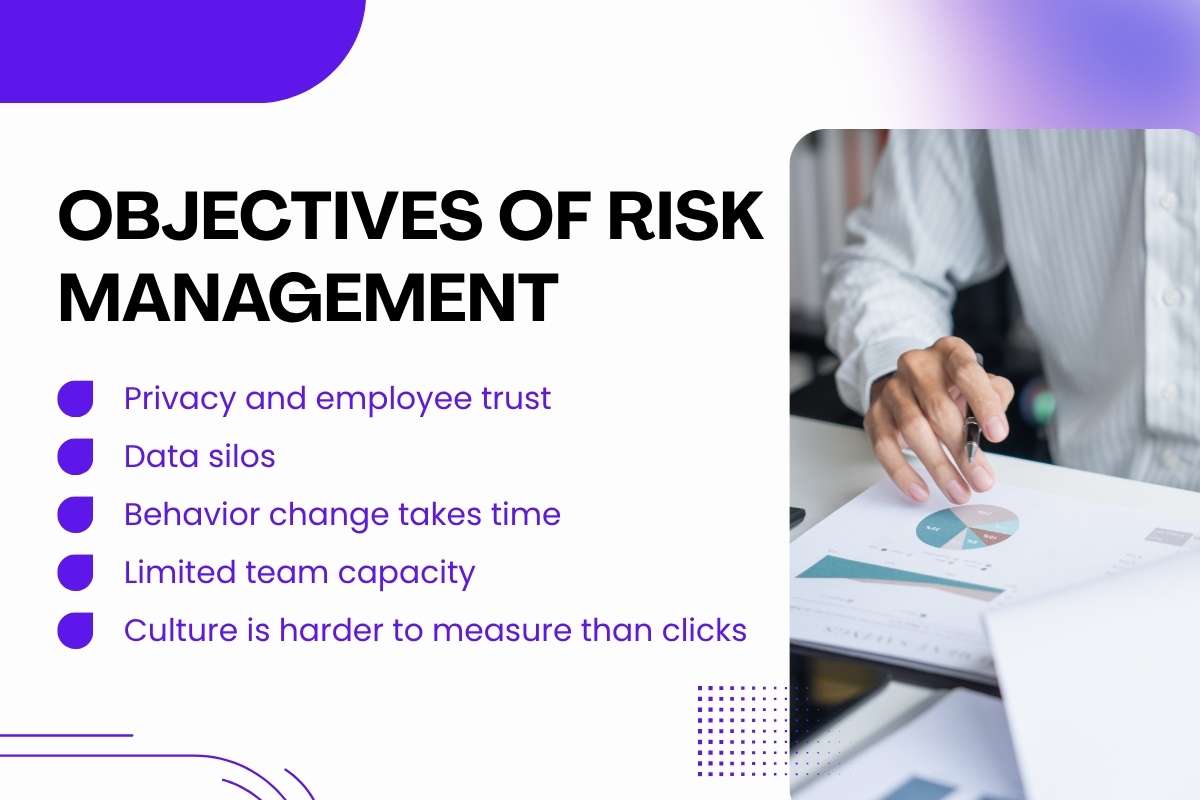
HRM gives results, but implementation is not smooth. Here are the main hurdles to plan for:
1. Privacy and employee trust:
Behavioral monitoring raises privacy concerns, particularly under GDPR. Be transparent about what is tracked and why. Otherwise, employees would lose trust and not report risky behavior.
2. Data silos:
HRM needs signals from email gateways, identity providers, and training platforms. Connecting these into a single risk view is one of the most common implementation barriers.
3. Behavior change takes time:
According to KnowBe4, phishing click rates drop by 40% within the first 90 days of training, and by 86% after 12 months. Results build over time, so set realistic expectations with leadership early on.
4. Limited team capacity:
Smaller security teams can struggle to act on risk data even when the platform shows it. AI-native platforms that automate interventions help reduce this burden.
5. Culture is harder to measure than clicks:
Phish-click rate is easy to track. How safe employees feel reporting mistakes is harder to measure, but matters more in the long run. Mature programs measure both.
The Bottom Line
Firewalls, endpoint protection, and access management still matter. But none of them stop a well-crafted social engineering attack aimed at an unprepared person.
The organizations that cut breach risk most effectively in 2026 are the ones that treat human behavior as something measurable. Human risk management gives you a clear path: find where the risk is, measure it, act on it, and keep improving.
1. Is HRM the same as security awareness training?
No. Security awareness training is part of HRM. HRM goes further by tracking behavior, scoring risk, and taking targeted action.
2. What is a human risk score?
A score that measures how likely a user is to cause a security incident based on behavior like phishing clicks, MFA usage, and training history.
3. Who owns HRM — security or HR?
Usually, it is owned by the security team under the CISO. HR team supports culture, privacy, and employee interventions.
4. Do small businesses need HRM?
Yes. Small businesses can afford and benefit from basic HRM practices like phishing tests and security training.
5. How is AI changing HRM in 2026?
AI deepfakes and voice clones can easily bypass traditional training. Modern defenses now use real-time AI risk scoring to support interventions for both employees and AI agents.