Data lies. Not because it wants to, but because humans and systems make mistakes.
A missing number, a wrong update, or a silent change can turn useful data into a problem. One small error can break reports, confuse teams, damage trust, or make leaders take the wrong decision. This is where what is data integrity becomes more important than flashy charts or big data buzzwords.
Data integrity is the quiet guard standing behind every correct number. It makes sure data stays accurate from the moment it is created to the moment it is used. It checks that nothing changes without reason and nothing goes missing along the way. Without data integrity, even the most advanced software starts acting confused, just like a new intern without instructions.
This guide explains what data integrity is in simple words.
What Is Data Integrity?
Data integrity at its core? It means data stays accurate, complete, and unchanged from start to finish. The data you enter should remain the same when stored, shared, or used later. No missing values. No silent changes. No confusion.
When people ask what data integrity is, they want to know if data tells the truth. Data integrity ensures that truth remains intact over time. It covers how data is created, saved, updated, transferred, and accessed.
Validity of data also includes protection from human mistakes, system errors, and unauthorized changes. If a customer record changes without reason, integrity fails. If a report shows wrong numbers, integrity breaks.
In simple terms, what is data integrity? It is the promise that data means the same thing today, tomorrow, and next year.
Why Is Data Integrity Important? Types of Data Integrity
Data drives almost everything today. Businesses plan budgets with it. Doctors treat patients with it. Governments make policies with it. When data is wrong, the damage spreads fast. That is exactly why data integrity matters so much.
At a basic level, data integrity means data stays correct, complete, and reliable. When integrity breaks, trust breaks too. A single wrong number can lead to poor decisions, wasted money, or legal trouble.
Think about dashboards, reports, and analytics. Leaders depend on them every day. They do not double-check every number. They assume the data is accurate. Data integrity makes sure that the assumption stays true.
Good integrity builds confidence. Teams trust reports. Customers trust services. Regulators trust records. Bad integrity creates doubt, confusion, and constant rework.
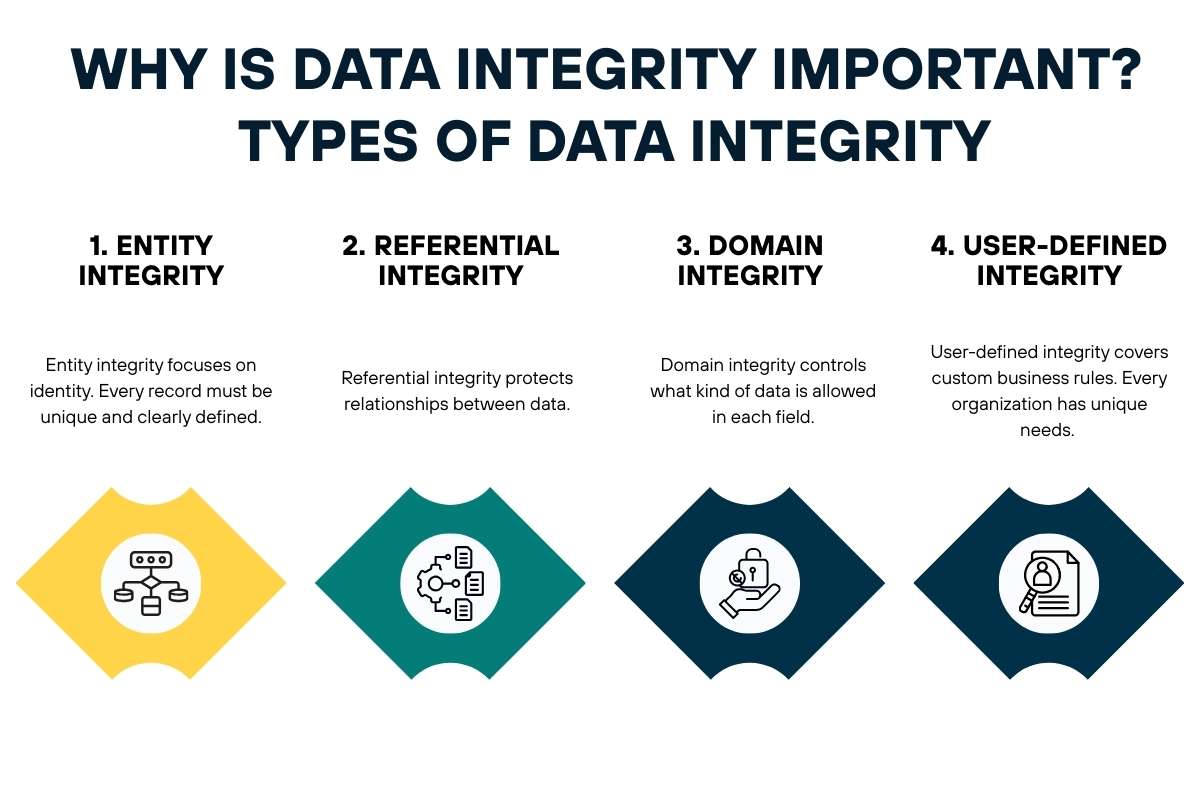
To understand what data integrity is, you must know its four main types. Each one protects data differently.
1. Entity Integrity
Entity integrity focuses on identity. Every record must be unique and clearly defined.
For example, each customer should have one unique ID. That ID cannot be empty. It cannot repeat. If two customers share the same ID, systems get confused. If an ID is missing, tracking becomes impossible.
Entity integrity ensures that:
- No duplicate records exist
- Every record can be identified.
- Data remains organized and traceable.
Without entity integrity, databases turn messy very fast. what is data integrity begins with knowing exactly who or what each record represents.
2. Referential Integrity
Referential integrity protects relationships between data.
For example, an order should always link to a valid customer. A payment should always connect to an existing invoice. If one record points to something that no longer exists, integrity breaks.
Referential integrity ensures that:
- Related data stays connected.
- Links between tables do not break.
- Deletions or updates do not create orphan records.
When referential integrity fails, reports show wrong totals, and systems behave unpredictably. Data integrity depends on these relationships staying intact.
3. Domain Integrity
Domain integrity controls what kind of data is allowed in each field.
A phone number should contain numbers. A date field should contain a real date. A price should never contain letters. These rules may sound basic, but they prevent countless errors.
Domain integrity ensures that:
- Data follows correct formats.
- Values stay within allowed ranges.
- Meaning remains clear and consistent.
When domain rules fail, systems accept junk data. Data integrity relies on clear rules that data must follow every time.
4. User-Defined Integrity
User-defined integrity covers custom business rules. Every organization has unique needs.
For example:
- An employee cannot have a negative salary.
- A discount cannot exceed a set limit.
- A delivery date cannot be before an order date.
These rules may not come built-in. Teams define them based on how the business works.
User-defined integrity ensures that:
- Data follows real-world business logic.
- Company-specific rules stay enforced.
- Systems reflect actual operations.
This type completes the picture of what data integrity is by aligning data with reality.
You may also like: What is a Hardware Security Module (HSM)?
Core Components of Data Integrity
To fully understand what data integrity is, you must understand the key building blocks that keep data reliable. These core components work together to protect data from errors, confusion, and silent damage. If even one part fails, trust in the data starts to fall apart.
Let’s break each one down in plain language.
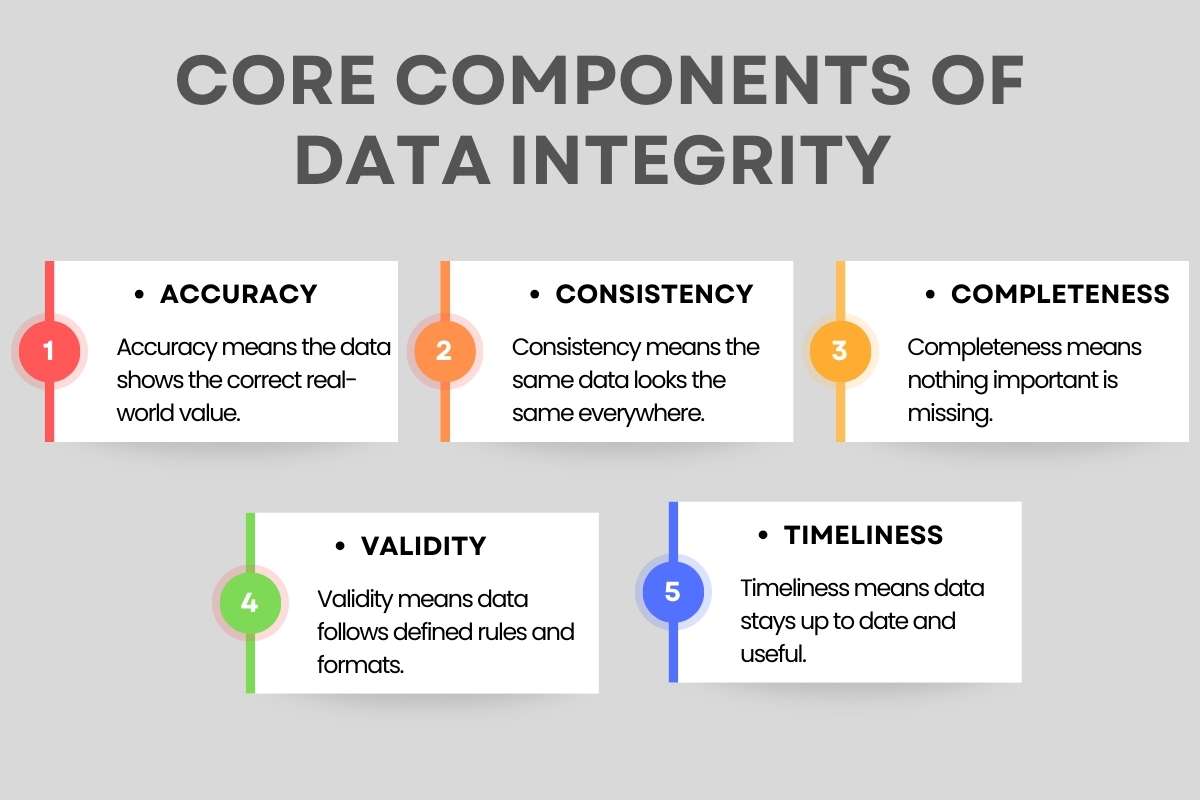
1. Accuracy
Accuracy means the data shows the correct real-world value.
If a customer’s age is 35, the database should say 35, not 53.
If a product costs ₹500, the system should not display ₹5,000.
Accuracy answers one simple question: Is the data true?
In data integrity, accuracy is the foundation. Even small mistakes can lead to wrong reports, bad decisions, or financial loss. Incorrect data spreads fast and becomes harder to fix later.
2. Consistency
Consistency means the same data looks the same everywhere.
If a customer name appears as “Rahul Sharma” in one system, it should not appear as “R. Sharma” or “Rahool Sharma” in another.
Consistency ensures:
- No mismatched records
- No conflicting reports
- No confusion between systems
When people ask what data integrity is, consistency explains why different teams should see the same information, no matter which tool they use.
3. Completeness
Completeness means nothing important is missing.
A customer record without a phone number.
An order without a delivery address.
A report with blank fields.
These gaps create problems.
Completeness ensures that data includes all required information, not half-filled records. In What is data integrity, incomplete data often causes delays, wrong assumptions, and extra manual work.
Good data tells the full story, not half of it.
4. Validity
Validity means data follows defined rules and formats.
Examples:
- Email fields contain real email formats.
- Dates follow a correct date structure.
- Age fields contain numbers, not text.
Validity prevents nonsense data from entering the system. It ensures data makes sense before it gets stored.
In data, validity acts like a gatekeeper. It stops bad data at the door instead of fixing it later.
5. Timeliness
Timeliness means data stays up to date and useful.
An old address.
An outdated phone number.
Last year’s sales data is used for today’s planning.
Even accurate data loses value when it becomes outdated.
Timeliness ensures that data reflects the current situation. In integrity, timely data supports faster decisions and better results. Old data creates modern problems.
Techniques for Maintaining Data Integrity

Understanding what data integrity is is only the first step. The real work starts when you protect data every single day. Data faces risks all the time. Human mistakes. System bugs. Unauthorized changes. These techniques act like daily safety habits that keep data clean, accurate, and trustworthy.
Let’s break them down one by one.
1. Validation Rules: Stop wrong data at the entry point
Validation rules act like a strict gatekeeper. They check data before it enters a system. If the data looks wrong, the system rejects it immediately.
For example:
- A phone number must have the correct number of digits.
- An email address must include “@”.
- A date cannot be in the future if the event has already happened.
These rules prevent errors before they start. They reduce manual cleanup later. They also protect data by ensuring only correct and meaningful data gets stored.
Think of validation rules as spellcheck for data. They stop nonsense before it becomes a problem.
2. Access Controls: Limit who can edit data
Not everyone should edit everything. Access controls decide who can view data, who can change it, and who cannot touch it at all.
For example:
- Employees can view customer records, but cannot change prices.
- Managers can approve changes.
- Admins control system-level updates.
When too many people have edit access, mistakes increase. Accidental deletions happen. Wrong updates slip in.
Access controls protect integrity by reducing unnecessary handling. Fewer hands mean fewer errors. Clear roles keep data safe and stable.
3. Audit Trails: Track every change clearly
An audit trail is a detailed history of data changes. It records:
- What changed
- Who changed it
- When it changed
- What the value was before and after
If data suddenly looks wrong, audit trails show the full story. No guessing. No blame games.
Audit trails support What is data integrity because they create accountability. People work more carefully when actions leave footprints. Systems become transparent. Errors become traceable and fixable.
4. Backups: Restore clean data when things go wrong
Even the best systems fail sometimes. Servers crash. Files corrupt. Updates break data.
Backups act like a time machine. They store clean copies of data at regular intervals. If something breaks, you restore data to a safe point.
Without backups, one mistake can destroy years of information. With backups, recovery becomes fast and calm.
Backups protect data by ensuring data does not vanish or stay damaged forever. They turn disasters into temporary problems.
5. Error Detection: Spot issues before they spread
Error detection tools watch data continuously. They look for:
- Missing values
- Sudden spikes or drops
- Duplicate records
- Inconsistent formats
When systems catch errors early, damage stays small. When errors go unnoticed, they spread across reports, dashboards, and decisions.
Error detection strengthens What is data integrity by acting like an early warning system. It helps teams fix problems while they are still manageable.
Data Integrity vs Data Security
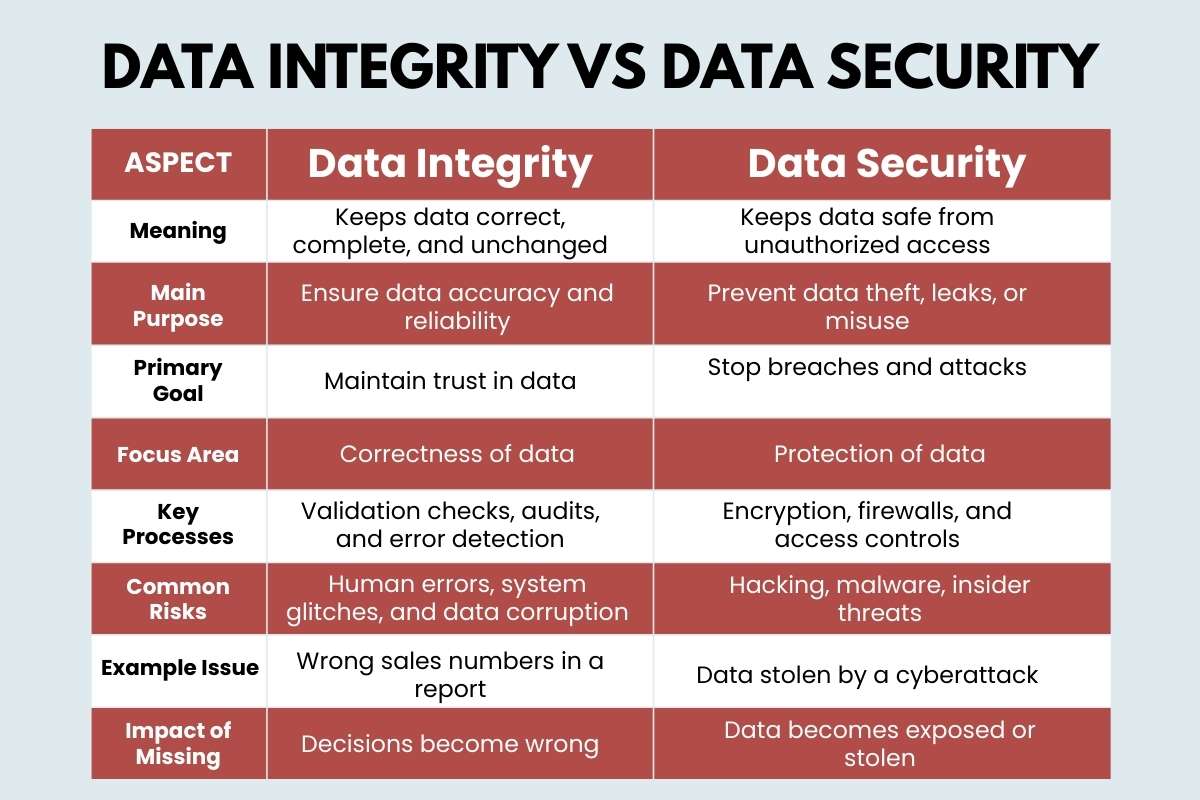
People often mix up what data integrity is with data security. This confusion is common. Both deal with data protection, but they solve different problems. They support each other, yet they are not the same.
Think of data as money in a bank.
- Data integrity makes sure the amount written on your balance slip is correct.
- Data security makes sure no one steals the money.
You need both. If one fails, the whole system becomes weak.
| Aspect | Data Integrity | Data Security |
| Meaning | Keeps data correct, complete, and unchanged | Keeps data safe from unauthorized access |
| Main Purpose | Ensure data accuracy and reliability | Prevent data theft, leaks, or misuse |
| Primary Goal | Maintain trust in data | Stop breaches and attacks |
| Focus Area | Correctness of data | Protection of data |
| Key Processes | Validation checks, audits, and error detection | Encryption, firewalls, and access controls |
| Common Risks | Human errors, system glitches, and data corruption | Hacking, malware, insider threats |
| Example Issue | Wrong sales numbers in a report | Data stolen by a cyberattack |
| Impact of Missing | Decisions become wrong | Data becomes exposed or stolen |
Tools and Technologies Used for Data Integrity
Modern digital systems handle massive amounts of data every second. To keep that data correct and reliable, they rely on specific tools and technologies. These tools protect What is data integrity at every stage, from data entry to storage and usage.
Let’s break each one down into very simple words.
1. Database Constraints
Database constraints act like strict rules inside a database. They stop wrong data before it enters the system.
For example, a database can force an email field to stay unique. It can stop empty values in critical columns. It can also limit numbers to a fixed range.
These rules protect data by preventing bad data at the source. Instead of fixing errors later, constraints stop mistakes early. This saves time and avoids confusion.
In simple terms, database constraints tell data how to behave and what is allowed.
2. Checksum Validation
Checksum validation works like a fingerprint for data. When data is created, the system generates a small code based on its content. When data moves or gets copied, the system checks that code again.
If the code changes, the data has changed.
This method protects data integrity during file transfers, backups, and storage. It helps detect corruption caused by network issues, disk failures, or system crashes.
Checksum validation does not fix data. It tells you when something went wrong. That warning alone prevents serious damage.
3. Version Control Systems
Version control systems track every change made to data or files. They record who made the change, when it happened, and what changed.
If someone makes a mistake, the system can roll back to an earlier version.
These systems support data by creating transparency and accountability. Nothing changes silently. Every edit leaves a trace.
This is especially useful in shared environments where many people work on the same data.
4. ETL Validation Tools
ETL stands for Extract, Transform, Load. These tools move data from one system to another.
During this movement, data can break, change format, or lose values.
ETL validation tools check data at every step. They compare the source data with the final output. They flag mismatches, missing records, or wrong formats.
This protects integrity when data travels across platforms, databases, or cloud systems. Without validation, small transfer errors can turn into big reporting problems.
5. Blockchain-Based Ledgers
Blockchain-based ledgers store data in blocks that link together. Once data enters a block, nobody can change it without leaving proof.
Every update creates a new record instead of altering the old one.
This structure strongly supports data integrity by making data tamper-resistant. It is especially useful for financial records, contracts, and audit logs.
Blockchain does not rely on trust. It builds trust through structure.
Also Read: How SASE (Secure Access Service Edge) Transforms Security? And Why You Can’t Ignore It in 2025?
Future of Data Integrity
The future looks stronger and smarter.
Automation will handle routine checks without human effort. AI systems will spot patterns that signal errors before they spread. Real-time validation will replace delayed audits.
Instead of discovering problems weeks later, systems will flag them instantly.
Governments and industries will also raise standards. New regulations will demand proof that data stays accurate, not just secure.
As data volumes grow, trust will become rare and valuable. Companies with strong integrity will earn confidence. Others will lose credibility fast.
Soon, what data integrity is will stop being a technical feature. It will become a basic requirement for survival in the digital world.
Conclusion
Think again about the confused intern. Without rules, even good intentions create mistakes. Data works the same way. Data integrity gives data clear discipline and direction. It keeps numbers honest and systems reliable.
In a world driven by data, success depends on trust. Clean data helps teams move faster, make better decisions, and avoid costly errors. Integrity works quietly in the background, doing its job without noise. When data stays clean, everything else falls into place.