Key Takeaways:
- Ruby on Rails vulnerability fixes address a critical flaw allowing unauthenticated server file reads.
- Crafted image uploads expose sensitive database credentials and environment keys.
- Developers urge immediate patching across multiple framework versions to block intrusions.
Ruby on Rails Patches Critical Flaw
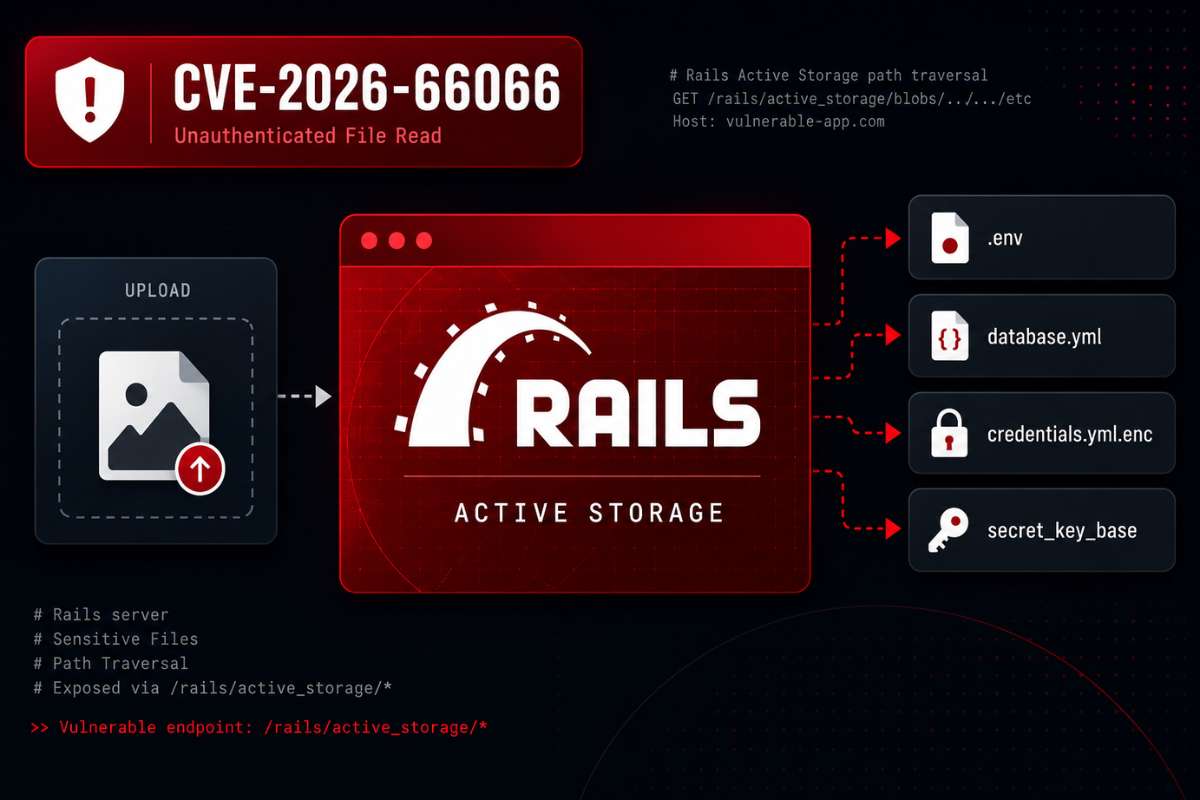
Ruby on Rails developers released emergency security updates on Wednesday to address a critical Ruby on Rails vulnerability that allows unauthenticated attackers to read arbitrary server files through crafted image uploads.
The security flaw, tracked as CVE-2026-66066 with a maximum severity CVSS score of 9.5, affects applications utilizing the Active Storage component configured with the libvips processor.
Researchers discovered that inadequate trust boundaries during image processing let hostile inputs bypass safety checks, exposing sensitive environment files and authentication tokens.
“This critical flaw exposes core configuration keys that could enable attackers to escalate privileges or move laterally across connected corporate networks,” said cybersecurity researcher David Miller.
Software maintainers stressed that prompt patch deployment is vital to prevent unauthorized system access.
Exposing Sensitive Environment Secrets
Successful exploitation of the Ruby on Rails vulnerability grants malicious actors immediate access to critical server secrets, including database passwords, cloud storage credentials, and API tokens.
Security analysts warn that leaked cryptographic keys can quickly facilitate full remote code execution if left unmitigated.
Impacted framework versions span multiple branches, including versions 7.0 through 7.2, along with recent 8.0 and 8.1 releases.
Organizations running older 6.x builds remain vulnerable only if manual configurations explicitly enabled the risky image processor.
“Operators must immediately update their systems and rotate all exposed master credentials to ensure complete server security,” noted software engineer Sarah Jenkins. Security teams confirmed that no automated exploits were actively targeting the flaw before disclosure.
Securing Application Infrastructure Fast
Web administrators are urged to apply official framework patches or invoke built-in blocking functions to disable unsafe operations within the image processing pipeline to mitigate the Ruby on Rails vulnerability.
Industry groups emphasize that proactive dependency management remains essential for defending complex web architectures. Technical auditors recommend conducting thorough log reviews to detect any unusual file access requests originating from untrusted upload endpoints.
Software developers continue refining default security postures to protect modern web applications from emerging attack vectors and future Ruby on Rails vulnerability risks.
“Protecting enterprise infrastructure requires constant vigilance against subtle vulnerabilities hidden deep inside standard open-source dependencies,” stated open-source security lead Marcus Vance. Development teams plan to release further technical guidance over the coming weeks.
Visit CyberPro Magazine For The Most Recent Information.