Security teams rarely deal with threats in just one place. An attack may begin with a phishing email, move through a stolen account, reach an endpoint, and then target a cloud application.
The problem is that each security tool may see only part of that activity.
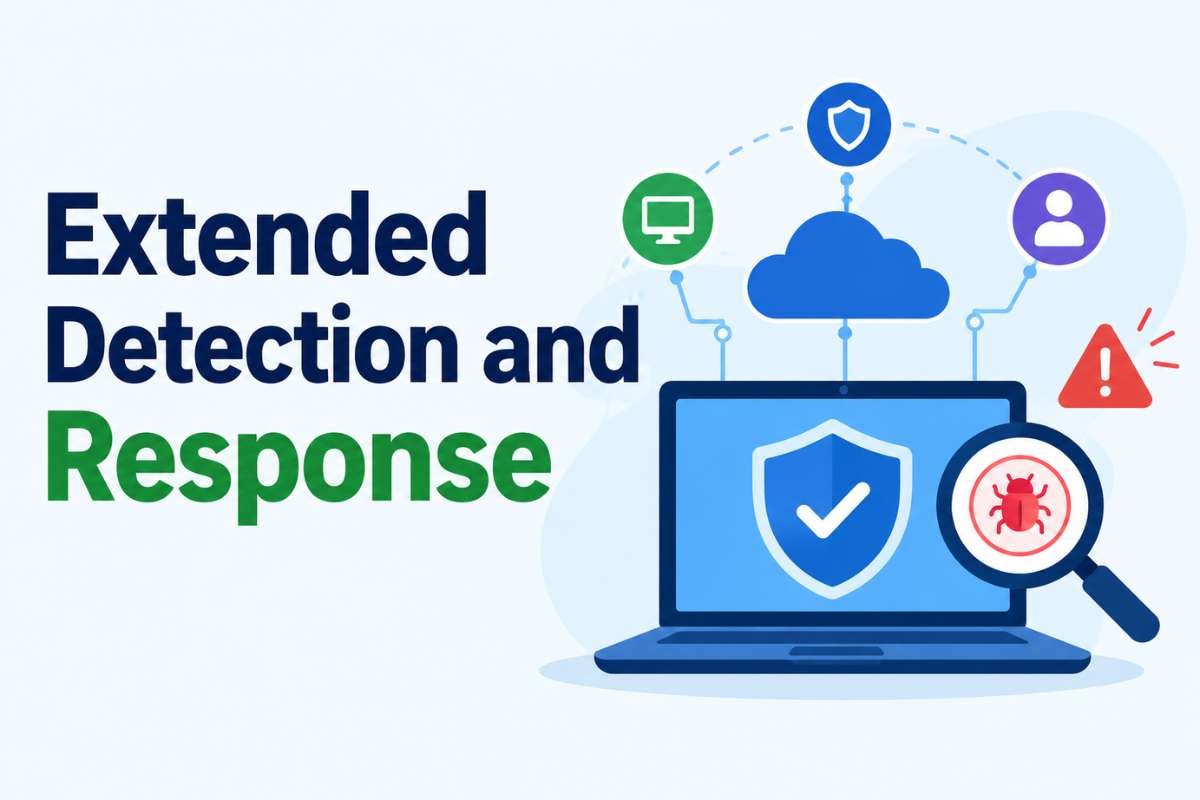
Extended Detection and Response (XDR) brings security signals from different parts of an environment together. It can connect data from endpoints, identity systems, email, networks, cloud workloads, and applications to help security teams detect, investigate, and respond to threats.
But XDR is not simply a wider version of EDR. Its value comes from connecting activity across security layers and adding context to individual alerts.
So, how does XDR work, where does it fit with other security technologies, and when does an organization actually need it?
What is Extended Detection and Response?
Extended Detection and Response is a security approach that collects and connects security information from multiple parts of an organization’s environment to support threat detection, investigation, and response.
Traditional endpoint detection and response (EDR) focuses mainly on devices such as laptops, desktops, and servers. XDR extends the view beyond those endpoints.
For example, consider a phishing attack:
- An employee receives a malicious email.
- The employee clicks a harmful link.
- An attacker gains access to the user’s account.
- The compromised account accesses an endpoint.
- The attacker connects to a cloud resource.
An endpoint tool may see step four. An email security tool may see step one. An identity system may record step three.
XDR aims to connect these events so security teams can investigate them as parts of the same incident. EDR provides deep visibility at the endpoint, while XDR provides broader visibility across multiple security domains. It also notes that XDR does not automatically replace EDR.
This distinction matters because XDR is not about collecting every possible security event. The goal is to make related activities easier to understand and act on.
How Does Extended Detection and Response Work?

At a high level, an XDR workflow looks like this:
Collect → Connect → Correlate → Investigate → Respond
The process starts by collecting security signals from connected tools and systems. These may include endpoint activity, login events, email alerts, network connections, cloud activity, and application events.
The platform then brings related signals together. A suspicious login by itself may not be enough to confirm an attack. But if that login is followed by an unusual endpoint process and access to a sensitive cloud resource, the combined activity may deserve immediate attention.
This is where cross-domain correlation becomes important. The final stages involve investigation and response. Analysts can examine the connected events, determine what happened, identify affected resources, and take actions based on the organization’s response process.
The exact workflow differs between platforms. Some XDR products have deeper native integrations, while others rely more heavily on connectors and APIs.
What Security Data Does XDR Connect?
XDR can connect security information from several layers of an IT environment. The exact coverage depends on the platform and its integrations.
| Security Domain | Example Signals | Why It Matters |
| Endpoint | Processes, files, device activity | Shows what is happening on devices |
| Identity | Logins, accounts, access events | Adds user and account context |
| Messages, links, attachments | Helps trace phishing activity | |
| Network | Connections, DNS and traffic activity | Shows how systems communicate |
| Cloud | Workloads, applications, access events | Extends visibility into cloud environments |
| Applications | Application activity and alerts | Adds application-level context |
IBM identifies users, endpoints, email, applications, networks, cloud workloads, and data among the areas that XDR can bring together.
The important point is not the number of integrations. More data does not automatically mean better detection.
If an XDR platform receives large amounts of disconnected or low-quality data, analysts may still struggle to understand an incident. The usefulness of XDR depends on the quality of the data, the depth of integrations, and how well the platform connects related activity.
Also Read: These 20 Network Security Companies are Changing the Cybersecurity Space in 2026
Why Does XDR Improve Threat Detection and Investigation?

A security alert often tells only part of the story. Imagine that an identity system reports an unusual login. On its own, an analyst may need more information before deciding whether it is malicious.
Now add several related events:
- The login came from an unusual location.
- A new device was used.
- A suspicious process appeared on that device.
- The account accessed a cloud application it rarely uses.
- A large amount of data was then transferred.
Each event provides another piece of evidence. XDR can connect these signals and help analysts see the wider incident rather than investigate every alert in isolation.
This can also reduce the need to switch between multiple security consoles during an investigation. The benefit is not simply speed. Better context can help analysts determine:
- What happened?
- Which user or device was involved?
- How did the attack move?
- Which systems may be affected?
- What response should happen next?
That makes XDR particularly useful for attacks that cross multiple security layers.
What is the Difference Between XDR and EDR?
EDR and XDR are closely related, but they operate at different levels.
| EDR | Capability | XDR |
| Endpoints | Primary focus | Multiple security domains |
| Deep | Endpoint visibility | Deep where integrated |
| Limited or integration-dependent | Cross-domain correlation | Core capability |
| Through integrations | Identity context | Often built into broader correlation |
| Through integrations | Email context | Can be part of cross-domain analysis |
| Through integrations | Cloud context | Can be part of broader visibility |
| Mainly endpoint-focused | Investigation scope | Cross-domain |
| Mainly endpoint | Response scope | Can coordinate across connected controls |
EDR remains important because endpoints provide valuable evidence about processes, files, users, and device activity.
In fact, many XDR environments build on EDR capabilities. Microsoft describes EDR as providing deep visibility into an individual security layer, while XDR expands visibility across several layers.
This endpoint-level visibility depends on how EDR collects and processes device activity. EDR Technology & Architecture explains the agents, telemetry, detection, investigation, and response controls that provide this foundation.
The simple distinction is this: EDR provides depth at the endpoint, while XDR adds breadth and cross-domain correlation.
How Does XDR Compare With SIEM, SOAR, NDR, and MDR?
XDR often appears alongside other security technologies, but they do not all perform the same job.
| Technology | Main Role |
| Endpoint Detection and Response (EDR) | Detects and responds to threats on endpoints |
| Extended Detection and Response (XDR) | Connects detection and response across security domains |
| Security Information and Event Management (SIEM) | Collects and analyzes security data across an environment |
| Security Orchestration, Automation, and Response (SOAR) | Automates and coordinates security workflows |
| Network Detection and Response (NDR) | Focuses on network activity and threats |
| Managed Detection and Response (MDR) | Provides managed security detection and response services |
A Security Information and Event Management (SIEM) platform generally has a broad role in collecting and analyzing security data. A Security Orchestration, Automation, and Response (SOAR) platform focuses on automating workflows and response actions.
The National Security Agency describes SOAR integration with EDR, SIEM, identity, and network security tools as part of automated incident response.
So, these technologies should not always be viewed as competing products. XDR may provide the cross-domain detection and investigation layer while SIEM and SOAR support broader data management and response workflows.
What Are the Main Benefits of Extended Detection and Response?
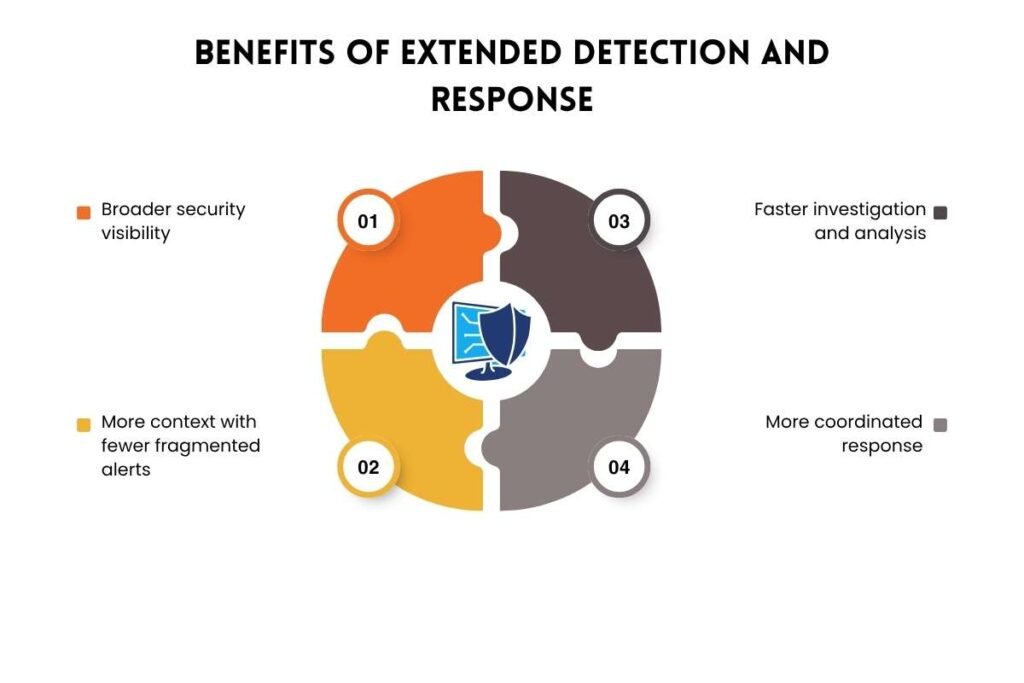
The biggest advantage of XDR is its ability to connect security events that may otherwise remain separated.
1. Broader security visibility:
XDR can bring activity from endpoints, identities, email, networks, and cloud systems into a connected view. This matters when an attack moves across multiple security layers.
2. More context with fewer fragmented alerts:
Instead of treating every alert as a separate event, XDR can group related signals around the same incident. Analysts can then see how different activities may be connected and focus on the evidence that matters.
3. Faster investigation and analysis:
Connecting related data reduces the need to switch between tools and manually compare events from different systems. This can help analysts understand what happened, which systems were affected, and how an attack progressed.
4. More coordinated response:
Where the right integrations are available, XDR can help security teams coordinate response actions across different controls. This can make it easier to contain activity that has spread beyond a single endpoint or security layer.
These benefits depend on implementation. XDR cannot create visibility into a system it cannot access, and an integration that provides limited data may provide limited context. The value comes from connecting the right data deeply enough to support real investigations and response.
What Are the Limitations of XDR?
XDR can simplify security operations, but it is not a shortcut around good security practices.
- Coverage gaps are one of the biggest concerns. If important systems are outside the platform’s integrations, the resulting view may still be incomplete.
- Data quality also matters. Poor, missing, or inconsistent telemetry can make cross-domain correlation less useful.
- Integration can become complex. Organizations may need to connect existing endpoint, identity, network, cloud, email, SIEM, and SOAR tools. Different products may offer different levels of data access and response control.
- Automation needs care. A response action that works well for a confirmed threat could disrupt if triggered by a false positive. The NSA recommends clearly defined response actions, testing, and controlled integration when automating security workflows.
There are also data governance and vendor dependency concerns. Organizations should understand where security data is stored, how long it is retained, who can access it, and how easily data and workflows can move between platforms.
The goal should not be to buy the platform with the longest feature list. A useful XDR platform gives the security team the right visibility, context, and response options for its environment.
When Does an Organization Need Extended Detection and Response?

XDR can make sense when security activity is spread across several tools and teams.
For example, an organization may have separate systems for endpoint protection, email security, identity, network monitoring, and cloud security. If analysts must investigate each alert in isolation, connecting the attack path can take more time.
XDR may be useful when:
- Security tools produce large numbers of disconnected alerts.
- Attacks regularly cross endpoint, identity, email, network, or cloud layers.
- Analysts spend too much time moving between security consoles.
- The security team needs a broader incident view.
- The organization wants more coordinated detection and response.
- Existing security tools can provide useful integrations and data.
Smaller organizations may also consider XDR, but size alone should not determine the decision.
Microsoft notes that the choice between EDR and XDR depends on factors such as the complexity of the environment, security maturity, and threat profile.
A simpler environment with a strong endpoint focus may not need the same cross-domain capabilities as a large, distributed environment.
How Should You Evaluate an XDR Platform in 2026?
Choosing an XDR platform should start with the organization’s security problems, not the vendor’s feature list.
| Evaluation Area | Key Question |
| Data coverage | Which security domains can it monitor? |
| Integrations | Does it connect with existing security tools? |
| Correlation | Can it connect related events across domains? |
| Investigation | Can analysts reconstruct an attack clearly? |
| Response | What actions can it take across connected controls? |
| Interoperability | Can it work with third-party technologies? |
| Data management | How are retention, storage, and access handled? |
| Scalability | Can it support the organization’s environment? |
| Operations | Can the security team manage it effectively? |
A useful evaluation starts with four simple questions: Can the platform collect the right data? Can it connect that data across security domains? Can analysts understand what happened? And can the organization respond safely?
The answers are more useful than simply counting integrations or detection features.
Organizations should also test the platform with realistic scenarios. A phishing attack that moves through identity, endpoint, and cloud systems is more revealing than a simple malware alert because it tests whether the platform can actually connect activity across domains.
Conclusion
Extended Detection and Response gives security teams a broader way to investigate threats that move across different parts of an environment.
As security environments become more connected, the key question is not how many alerts a platform can collect. It is whether the security team can turn activity across different systems into a clear picture of what is happening and what to do next.
FAQs
Can XDR Automate Incident Response?
Yes. XDR can automate certain response actions, such as isolating an endpoint, blocking malicious activity, or disabling compromised accounts. The level of automation depends on the platform, integrations, and response policies in place.
Does XDR require an existing EDR solution?
Not necessarily. However, EDR can provide detailed endpoint data that strengthens an XDR deployment. Whether EDR is required depends on the XDR platform and the organization’s existing security setup.
How is Extended Detection and Response deployed?
XDR is commonly delivered as a cloud-based security service, although deployment options and data-handling models vary between providers. Organizations should check hosting, data location, connectivity, and integration requirements before deployment.
How much does XDR cost?
Its pricing varies by provider and may depend on factors such as the number of users or endpoints, data volume, features, integrations, and service level. Organizations should compare pricing against their actual coverage and operational needs rather than the number of features alone.