
With social media, we have been disenchanted and detached. Humans are no longer humans; there are social media handles. They are combinations of words and symbols far from our point of view. We can say anything without thinking about the effect it will have on the person on the other side of the screen.
“Unless and until our society recognizes cyberbullying for what it is, the suffering of thousands of silent victims will continue.”
Anna Maria Chavez
Did you know one in six school-age kids in Europe gets cyberbullied? In the United States, nearly half of the teens (46%) faced cyberbullying.
Cyberbullying is a universal problem, and everyone is suffering from it. And while governments are working hard to stop all types of cyberbullying, are they succeeding? Can they succeed without people’s assistance? To stop cyberbullying, we must be aware of it, and that’s what this blog is about.
Breaking Down Cyberbullying: What Makes Online Harassment More Than a Mistake?
Anti-bullying activist, Bill Belsey, coined the term “cyber-bullying” to describe a hostile, repeated online behavior intended to harm others. According to Cyberbullying.org, it is the wilful, repeated harm inflicted through the use of devices such as computers and mobile phones.
So, based on this definition, we understand a couple of things about the nature of cyberbullying.
- It is a wilful act. It is a deliberate act, not an accidental one.
- It is repetitive. See, bullying is a pattern, not an isolated incident.
- It is harmful, but with cyberbullying, the harm is not physical but mental.
And there are many types of cyberbullying. Here’s an overview of them:
| Type of Cyberbullying | Description |
|---|---|
| Cyber Harassment | Repeated offensive, abusive, or threatening messages across texts, emails, or DMs. |
| Impersonation | Using fake profiles to pose as someone and post harmful content in their name. |
| Denigration / Gossiping | Spreading lies, rumors, or false information to damage someone’s reputation. |
| Outing / Exposure | Sharing private or embarrassing information or images without consent. |
| Cyberstalking | Persistent monitoring, threats, or unwanted contact across platforms. |
| Doxxing | Publishing personal details such as addresses or phone numbers invites harassment. |
| Sextortion / Revenge Porn | Threatening to leak intimate images or sharing them without consent. |
| Trolling | Posting inflammatory content to provoke emotional reactions. |
| Swatting | Making false emergency reports to send police to someone’s location. |
| Hate Raids | Organized attacks flood accounts with hateful messages or spam. |
Understanding the 10 Types of Cyberbullying through Real Stories
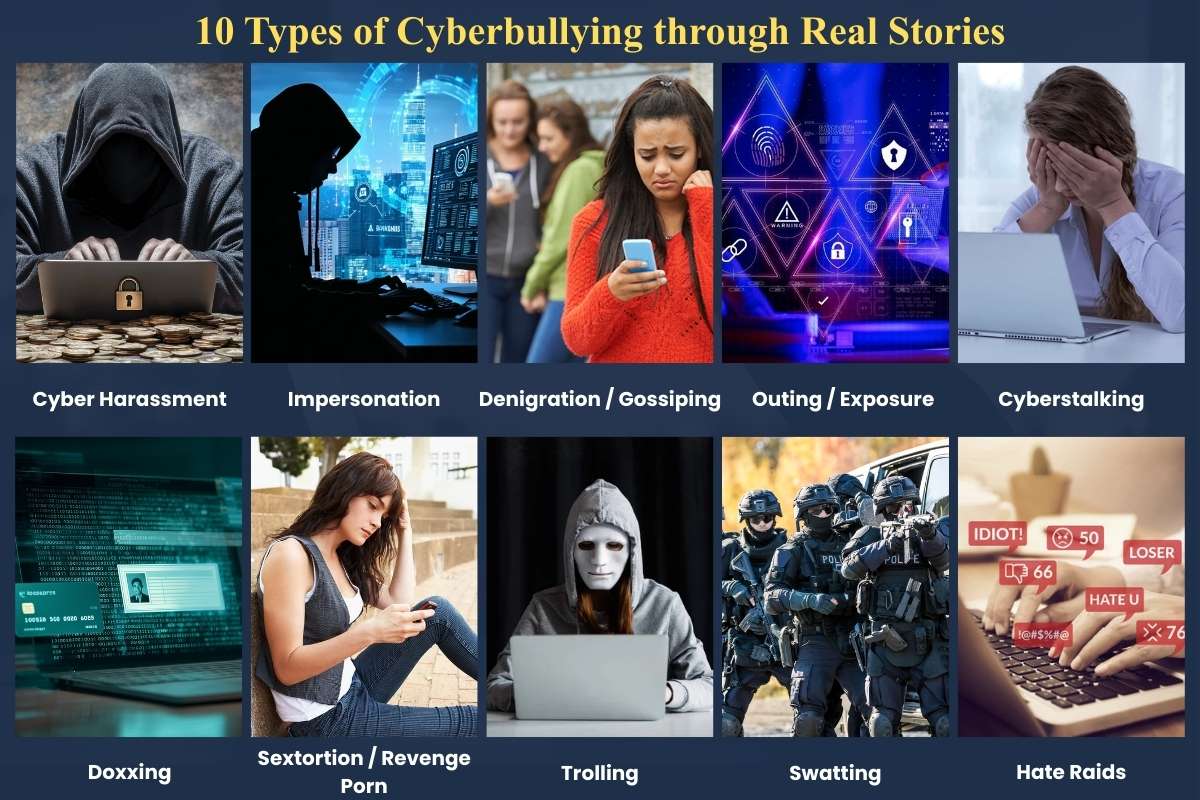
Let’s take a deeper look at these types and some real-life examples. It will help us better understand the effects of cyberbullying.
1. Cyber Harassment
Sending offensive, threatening, abusive, or derogatory messages repeatedly is considered cyber-harassment. It doesn’t matter whether you are sending these messages through emails, comments, DMs, etc. If the goal of these messages is to humiliate and abuse someone, it is cyberbullying.
Real-Life Example: Amanda Todd Case (2012)
Canadian teen Amanda Todd endured years of harassment after an inappropriate photo of her as a 12-year-old was shared online without her consent; an adult male stalker repeatedly contacted her via Facebook with threats to distribute it further unless she complied with demands. He sent harassing messages across platforms, doxxed her new locations after she moved schools multiple times, and incited others to join in.
All of this culminated in her taking her own life at 15. Later, the harasser faced 13 years in prison for related charges, including harassment and extortion. This case exemplifies how digital harassment can track and terrorize victims relentlessly.
2. Impersonation

The name explains the type perfectly. When a person pretends to be someone they are not, they may scam others or post harmful, embarrassing information about themselves. The scary part about impersonation is that it can spread other types of cyberbullying, leading to serious repercussions and even to some serious crimes.
Real-Life Example: Lori Drew Case (United States v. Drew, 2006-2009)
Lori Drew and associates created a fake MySpace profile as “Josh Evans,” a teenage boy, complete with fabricated photos and details to befriend 13-year-old Megan Meier, monitor her interactions with Drew’s daughter, then turn abusive by posting messages like “the world would be better without you,” contributing to Meier’s death.
The impersonation led to emotional manipulation and public humiliation when details emerged; Drew was initially convicted on related charges but acquitted on appeal due to legal overreach. This case spurred debates on cyberbullying laws and platform accountability.
3. Denigration / Gossiping
If someone spreads lies, rumors, or derogatory comments about someone online, they are committing denigration. Gossiping may seem like a simple, harmless act, but when done with malice, it can lead to harm. When the goal is to humiliate someone or isolate them, it is a serious crime.
Real-Life Example: Phoebe Prince Case (2010)
In Massachusetts, 15-year-old Irish immigrant Phoebe Prince was subjected to relentless denigration by peers after a brief romance; they posted cruel rumors on Facebook, calling her “an Irish slut” and “whore,” shared mocking messages, and created hate pages labeling her promiscuous.
The gossip spread across social media and texts, alienating her at school and contributing to her death; six teens faced charges, including criminal harassment and civil rights violations, with some pleading guilty to lesser offenses. This tragedy led to the expansion of cyberbullying into the anti-bullying laws in Massachusetts.
4. Outing / Exposure

If someone obtains another person’s private information, in any form, and releases it to the public against their consent, it is an illegal and punishable crime. This is what we call exposure or outing, an act of exposing someone against their will. This exposure may include their private information, such as personal messages, photos, videos, sexual orientation, medical details, or secrets.
Real-Life Example: Tyler Clementi Case (2010)
Rutgers University freshman Tyler Clementi had an intimate encounter with a male partner that was secretly webcammed and live-streamed by his roommate, who then tweeted about it to expose Clementi’s sexuality without consent, leading to widespread gossip and humiliation. The accused posted updates such as inviting others to watch a second encounter and outing Clementi online.
Overwhelmed by the incident, Clementi later jumped off the George Washington Bridge. The accused was convicted of bias intimidation and invasion of privacy (later overturned on appeal to lesser charges). He was sentenced to 30 days in jail, sparking U.S. campus anti-bullying policies and the Tyler Clementi Foundation.
5. Cyberstalking
Persistently monitoring someone’s activities online is called cyberstalking. It is also an offensive crime that can lead to imprisonment. If someone harasses you and breaches your privacy by stalking you continuously, you must report them to the police and cyber protection agencies. This type of cyberbullying aims to control, frighten, or isolate the target. It can lead to paranoia, anxiety, physical danger, and other types of cyberbullying.
Real-Life Example: Gary Dellapenta Case (1999, USA)
Gary Dellapenta, rejected romantically by a woman in California, engaged in cyberstalking by posting fake online ads in her name, advertising sexual services. These advertisements included her home address and instructions to bypass her security system.
It led to obscene messages flooding her inbox and strangers arriving at her door seeking encounters, terrorizing her safety and privacy. Later, Dellapenta was found guilty of the crimes under California’s new anti-cyberstalking law, the first such case, receiving a six-year prison sentence.
Also Read: Cyberbullying Laws: Protecting Lives, Rights, and Online Communities
6. Doxxing
Doxxing is maliciously researching about someone and exposing their private personal information. It includes home addresses, phone numbers, email addresses, workplace details, family member names, or Social Security numbers. The word is derived from the term “dropping documents,” which explains it perfectly.
Real-Life Example: Gamergate Doxxing of Zoe Quinn (2014)
Game developer Zoe Quinn was doxxed during the Gamergate controversy when harassers published her home address, phone number, and family details on sites like 4chan and Reddit after disputing her personal life; this triggered death threats, swatting attempts, and forced her into hiding.
The coordinated attacks involved thousands participating, leading to FBI investigations but few convictions due to anonymity; Quinn relocated and advocated for anti-harassment laws, highlighting doxxing’s role in gendered online violence.
7. Sextortion / Revenge Porn

Sextortion involves coercing a victim into providing money, more explicit content, or sexual acts by threatening to distribute intimate images or videos they previously shared. These videos are often obtained through deception, hacking, or trust-building on platforms like social media or dating apps.
Real-Life Example: Jordan DeMay Case (2022, USA)
15-year-old Michigan teen Jordan DeMay was sextorted after sharing a nude selfie with someone he met on Snapchat, who then demanded $300 and more images, threatening to send the photo to his friends and family. When he did not pay, the criminals distributed the image online.
Overwhelmed by humiliation, DeMay alived himself; the Nigerian perpetrator was charged federally but killed himself, while two others faced U.S. indictments. This case prompted FBI alerts on rising teen sextortion deaths.
8. Trolling
Trolling means deliberately posting something inflammatory, provocative, off-topic, or malicious comments online to elicit strong emotional reactions. Now, this is a common occurrence on Instagram. And while some may be harmless in nature, continuous trolling and provocative comments can lead to mental health issues.
Real-Life Example: Hana Kimura Case (2020, Japan)
Professional wrestler Hana Kimura faced relentless trolling after appearing on Terrace House; anonymous Twitter users bombarded her with thousands of hateful messages calling her “disgusting,” mocking her appearance, and urging her to unalive herself, escalating from reality TV drama.
And at the age of 22, she took her own life; Japanese police charged two trolls with abetment to suicide. It marked Japan’s first such convictions under cyberbullying laws. It prompted platform reforms such as easier blocking.
9. Swatting
Now, this might be the most dangerous of all the types of cyberbullying. It can endanger the victim’s life, and the worst part? It is a waste of taxpayers’ money. Swatting is a dangerous escalation tactic where a perpetrator makes hoax emergency calls (e.g., to 911), falsely reporting severe crimes such as shootings, bombings, or hostage situations at the victim’s address.
Real-Life Example: Andrew Finch Case (2017, USA)
During a Call of Duty stream dispute, 25-year-old Tyler Barriss doxxed rival gamer Andrew Finch by posting his Kansas address online, then called police claiming a murder and armed kidnapping inside; SWAT raided Finch’s home, and in the chaos, an officer fatally shot Finch, who was unarmed and investigating the commotion.
Barriss pleaded guilty to federal charges. He received 20 years’ imprisonment for his crime; two accomplices got lesser sentences. This incident led to U.S. legislative pushes like the Interstate Swatting Hoax Act.
10. Hate Raids

It is a coordinated attack on social media chats, livestreams, and other online spaces. Many times, bots start spamming slurs, random words, or threats in chats and comments. The goal is to disrupt the post or stream, overwhelm moderation tools, derail content creation, and amplify psychological harm through visible mob attacks. YouTube, Twitch, and Discord are the most common places for these types of attacks.
Real-Life Example: Indya Moore Twitch Raids (2020)
Non-binary actor Indya Moore’s Twitch stream was attacked by hate raids from alt-right groups flooding chat with anti-trans slurs, death threats, and spam during a live discussion; thousands of messages overwhelmed the channel, forcing it offline amid doxxing attempts.
Twitch banned involved accounts and improved raid protections post-incident, but Moore faced ongoing trauma. This spurred platform-wide anti-hate raid policies amid rising attacks on LGBTQ+ creators.
Also Read: The Hidden Scars: Cyberbullying Effects on Mental Health
Reading the Behavioral Clues That Point to Cyberbullying
Now let’s talk about the warning signs of cyberbullying. We will take a look at two types of warning signs. We will learn how to determine whether your child is the victim of cyberbullying or a perpetrator of it.
Warning Signs a Child May Be a Victim
- Victims often exhibit sudden behavioral shifts tied to device use, reflecting emotional distress from online abuse.
- Unexpectedly stops using devices or appears nervous/jumpy when receiving notifications.
- Becomes withdrawn, angry, depressed, or frustrated after online activity; shows changes in sleep, eating, or mood.
- Avoids school, peers, or discussions about online life; declines in grades or fakes illness to stay home.
Warning Signs a Child May Be a Perpetrator
- Perpetrators display secretive or aggressive online habits, often with multiple accounts.
- Uses devices excessively at night, laughs oddly while online, or gets upset if access is restricted.
- Hides screens quickly, uses non-personal accounts, or shows increased behavioral issues at school.
- Demonstrates callousness toward others or obsesses over online popularity.
We know the types of cyberbullying, we know the signs; let’s learn prevention.
How Can We Work Together to Prevent Cyberbullying?
“Never be bullied into silence. Never allow yourself to be made a victim.”
Robert Frost.
Preventing cyberbullying isn’t a single person’s job. It has to be our collective responsibility to fight it. The first step is to speak up. If you have faced any of the types of cyberbullying, speak up against it.
Here’s how everyone can work together to prevent it:
Prevention for Victims
- Educate users on privacy settings and safe online habits to minimize risks from the start.
- Adjust platform privacy to limit who sees posts, friends’ lists, or location; avoid sharing personal details like addresses or school names.
- Use strong, unique passwords with two-factor authentication; report and block abusers immediately without responding.
- Keep devices public but supervised; screenshot evidence of abuse before deleting for potential reports to authorities or platforms.
Prevention for Parents and Educators
- Proactive monitoring and open communication build resilience and early detection.
- Discuss online risks regularly without judgment; review device history and set time limits using parental controls.
- Teach digital citizenship in schools, emphasizing empathy and consequences; foster bystander intervention by encouraging reports.
- Collaborate with platform tools such as family safety centers on Instagram or TikTok for content filters.
Broader Societal Strategies
- Policy and tech solutions address root causes through awareness and enforcement.
- Advocate for stronger laws, such as India’s IT Act. We must support campaigns such as Safer Internet Day.
- Platforms should enhance AI moderation, easy reporting, and user verification to curb anonymity.
How do Countries Across the Globe Address Cyberbullying Legally?
Almost every country in the world has laws against all types of cyberbullying to some extent. Here are some of them you must know about:
1. United States:
All 50 states plus D.C. address bullying, with 48 having specific cyberbullying provisions. There are also federal laws, such as the Children’s Internet Protection Act (CIPA) support schools, but no standalone federal cyberbullying statute exists. And that is why such cases fall under harassment or CFAA.
2. Canada:
Canada is the strictest country for cyberbullying globally. The Education Act allows suspension/expulsion for cyberbullying. Every offender faces jail under Criminal Code §264.3 (uttering threats) or §162 (voyeurism).
3. United Kingdom:
The UK has theMalicious Communications Act 1988 to fight against types of cyberbullying. You can get up to 6 months in prison and fines for cyberbullying messages. And the Protection from Harassment Act 1997 covers stalking.
4. European Union:
Cyberbullying laws vary by member state. For example, the Budapest Convention on Cybercrime (2001) enables cross-border cooperation. Germany’s NetzDG (2017) requires platforms to remove hate speech in 24 hours or face fines. France’s Penal Code criminalizes repeated online harassment/stalking.
Conclusion:
Cyberbullying is a dangerous threat to modern life, especially for children and teenagers. With every advancement in technology, our kids are exposed to all kinds of online content. We must protect them from these types of cyberbullying. As it can lead to physical harm and, in some cases, it can lead to them harming themselves.
Governments can implement laws, but well-aware citizens are the only ones who can uphold them. It is important to look for the warning signs, keep tabs on your child’s activities, and keep a close eye on the smallest of details. But this does not allow disturbing their privacy, but rather protects it better.
FAQs
1. How can I report cyberbullying?
Use the reporting tools on the specific platform (e.g., Instagram, TikTok) and save evidence.
2. What are the effects of cyberbullying?
It can cause severe emotional distress, depression, anxiety, and impact school performance.
3. How can I prevent cyberbullying?
Be mindful of your digital footprint, use strong privacy settings, and never share passwords.