Running a company where nobody knows which spreadsheet is correct. Sales says one number. Finance shows another. Marketing pulls data from a mysterious folder called “Final_Version_Really_Final.” Chaos, right?
Welcome to the real world of messy business data.
Now picture a smart system that organizes everything, tracks who changed what, protects sensitive information, and makes data reliable again. That is where data governance tools step in, like strict but helpful librarians for your data universe.
They keep data clean, safe, and easy to trust. Because when businesses trust their data, decisions improve, risks shrink, and teams stop arguing about spreadsheets.
Why Businesses Need Data Governance Tools?
Organizations now generate more data than ever before. Sales records, customer information, analytics dashboards, IoT data, and cloud systems create a complex information environment.
Without proper structure, that environment becomes risky and inefficient.
This is why companies rely on governance tools to control the growing complexity of data ecosystems.
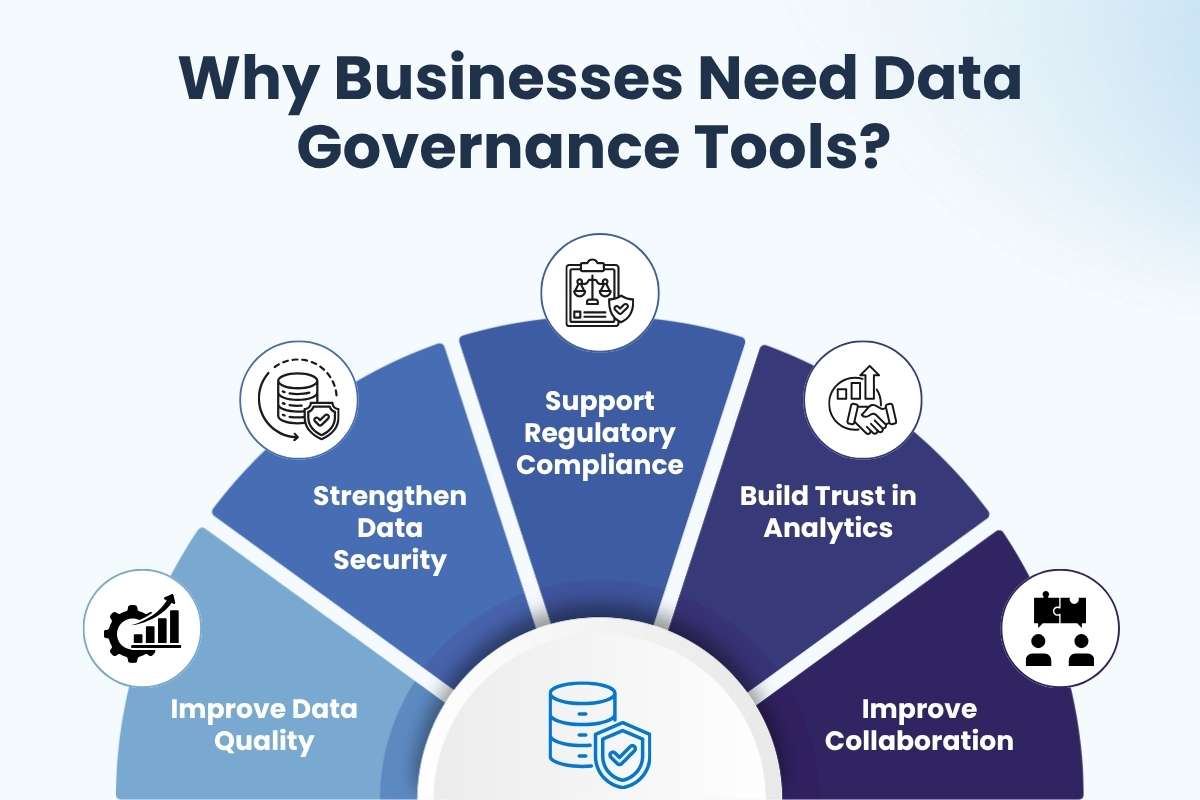
- 1. Improve Data Quality: Poor data leads to poor decisions. Businesses use these tools to maintain clean, accurate, and consistent information across systems.
- 2. Strengthen Data Security: Sensitive information such as financial records and personal data must stay protected. Data governance tools help enforce strict security rules and monitor access.
- 3. Support Regulatory Compliance: Many industries must follow strict data regulations. Using data tools helps organizations document policies and prove compliance during audits.
- 4. Build Trust in Analytics: Executives rely on dashboards and reports to make decisions. Reliable insights only come from reliable data, and these tools ensure that the foundation remains strong.
- 5. Improve Collaboration: Clear data ownership and structured information help teams work together without confusion or duplicated work.
Top 15 Data Governance Tools
Many platforms help organizations manage data governance effectively. Each tool offers unique strengths depending on business needs. Below are some widely used solutions.
1. Collibra
Collibra is one of the most popular enterprise platforms used to organize and manage company data. Large organizations often store data across many systems, such as cloud platforms, databases, analytics tools, and internal applications. Without structure, it becomes difficult to know where important data exists or whether it is reliable.
Collibra helps solve this problem by creating a centralized environment where teams can understand and manage their data assets. It acts like a digital directory for all organizational data. Employees can easily search, track, and understand the origin of data.
The platform also allows companies to define clear governance rules so that data stays accurate, secure, and compliant with regulations.
Key Features:
- Data catalog
- Data lineage tracking
- Governance workflow automation
Benefits:
- Strong collaboration features
- Excellent data cataloging capabilities
Limitations: Implementation can be complex for small teams
2. Informatica Axon
Informatica Axon focuses on creating a structured governance framework that connects business teams and technical teams. Many companies struggle because business leaders understand the meaning of data, while IT teams manage the technical systems.
Axon bridges this gap by providing a shared platform where both groups can define data policies, data ownership, and data standards.
The tool helps organizations build strong governance practices while improving the reliability of business reports and analytics.
Key Features:
- Metadata management
- Data quality monitoring
- Governance policies
Benefits:
- Enterprise-grade governance framework
- Strong integration with analytics tools
Limitations: Higher cost for smaller organizations
3. Alation
Alation is widely known for its modern data catalog and intelligent search capabilities. Organizations often struggle to locate reliable data sources. Analysts spend hours searching databases or asking colleagues for information.
Alation simplifies this process by building a smart catalog where users can quickly search for datasets, understand them, and use them confidently.
The platform also uses machine learning to recommend useful data sources and highlight frequently used datasets.
Key Features:
- Data catalog
- Machine learning insights
- Data search functionality
Benefits: Helps teams quickly locate trusted data sources and improves productivity with modern data governance tools capabilities.
Limitations: Requires data maturity to get full value.
You may also like: Pen Testing Tools Built for Compliance, Scale, and AI-Driven Threats in 2026
4. Talend Data Fabric
Talend Data Fabric is a unified platform that combines data integration, data quality management, and governance capabilities. Many organizations use different tools for integration and governance, which creates complexity.
Talend solves this problem by providing one platform that manages the entire data lifecycle.
The tool allows companies to collect data from various sources, clean it, organize it, and apply governance policies. This makes data more reliable for analytics and business operations.
Key Features:
- Data integration
- Data quality management
- Governance controls
Benefits: Combines integration and governance into one platform.
Limitations: Learning curve for beginners.
5. IBM Watson Knowledge Catalog
IBM Watson Knowledge Catalog is a modern governance platform that uses artificial intelligence to manage and organize data assets. Many companies operate with large volumes of data stored in cloud platforms and data lakes.
This tool helps businesses organize those large datasets while ensuring compliance and security.
The platform automatically scans datasets, classifies sensitive information, and enforces governance policies.
Key Features:
- AI-powered data catalog
- Policy enforcement
- Data classification
Benefits: One of the most advanced AI-driven data governance tools available today.
Limitations: Works best within the IBM ecosystem.
6. Microsoft Purview
Microsoft Purview is a powerful data governance platform designed to help organizations manage and monitor their data across cloud systems, on-premise databases, and hybrid environments. It gives companies a clear view of where their data exists, how it moves, and who can access it.
Many organizations use Microsoft Purview because modern businesses store information in multiple locations, such as data warehouses, cloud platforms, and analytics tools. Without a central system, tracking and protecting that data becomes difficult. Microsoft Purview solves this challenge by acting as a central governance hub.
Key Features:
- Data discovery
- Data lineage
- Compliance management
Benefits: Strong integration with Microsoft Azure environments.
Limitations: Less flexible outside Microsoft systems.
7. Atlan
Atlan is a modern data governance platform built to improve collaboration between data teams and business users. It acts as a shared workspace where teams can organize, document, and manage data assets in one central location.
Unlike traditional governance platforms that focus only on technical users, Atlan is designed for both technical and non-technical teams. Analysts, engineers, and business leaders can all work together inside the same data environment.
Key Features:
- Collaborative data workspace
- Metadata management
- Data discovery
Benefits: Modern interface and strong collaboration tools.
Limitations: Still growing in enterprise capabilities.
8. Oracle Enterprise Data Management
Oracle Enterprise Data Management is a governance platform designed to manage and control enterprise data structures. It focuses heavily on maintaining consistency in business data, especially in financial systems, enterprise applications, and large databases.
Many organizations deal with complex data hierarchies. For example, financial departments track departments, accounts, cost centers, and reporting structures. Managing these structures manually often leads to errors. Oracle Enterprise Data Management helps companies maintain consistency across these complex hierarchies.
Key Features:
- Data hierarchy management
- Governance policies
- Workflow automation
Benefits: Strong solution for financial and enterprise data.
Limitations: Best suited for organizations already using Oracle systems.
9. SAP Data Intelligence
SAP Data Intelligence is an enterprise data management and governance platform designed to integrate, process, and monitor data across complex environments. It allows organizations to connect multiple data sources and transform raw data into meaningful insights.
Large enterprises often operate dozens of databases, analytics systems, and applications. Managing these systems individually creates inefficiencies. SAP Data Intelligence acts as a central platform that coordinates and controls these data operations.
Key Features:
- Data orchestration
- Metadata tracking
- Governance controls
Benefits: Powerful for companies running SAP infrastructure.
Limitations: Complex setup.
10. DataGalaxy
DataGalaxy is a data knowledge platform designed to help organizations understand and document their data assets. It focuses on creating a clear map of how data flows across the organization and how different datasets relate to each other.
Many companies struggle because employees do not fully understand the data available to them. DataGalaxy addresses this issue by providing a clear data knowledge catalog.
Key Features:
- Data knowledge catalog
- Collaboration tools
- Data mapping
Benefits: Helps teams understand and trust organizational data.
Limitations: Limited integrations compared to larger vendors.
You may also like: Is Your Company’s Data Safe? Here are 8 Data Loss Prevention Tools for Concrete Security
11. OvalEdge
OvalEdge is a modern platform designed to simplify data governance for organizations that deal with large and scattered data environments. Many companies store data across multiple systems such as databases, analytics platforms, and cloud storage. OvalEdge helps bring all this information into one structured framework so teams can understand, access, and manage data easily.
The platform acts like a central library for business data. Instead of searching through different systems, users can open the data catalog and quickly identify where the required data exists, who owns it, and how reliable it is.
Key Features:
- Data catalog
- Governance automation
- Data lineage
Benefits: Improves data transparency with structured governance.
Limitations: The user interface could improve.
12. Precisely Data360
Precisely Data360 is a data governance and metadata management platform designed to help businesses understand complex data pipelines. In modern organizations, data flows through multiple applications, databases, and analytics systems. Tracking these flows manually becomes extremely difficult.
This is where Precisely Data360 becomes valuable. It visualizes how data moves across systems so teams can understand its journey and maintain control.
Key Features:
- Metadata management
- Data lineage visualization
- Governance automation
Benefits: Strong visualization of data pipelines.
Limitations: Enterprise-focused pricing.
13. Erwin Data Intelligence
Erwin Data Intelligence is a governance platform focused on helping organizations understand complex data environments. Large businesses often manage thousands of databases, applications, and reporting tools. Without proper structure, this environment becomes extremely difficult to manage.
Erwin helps companies create a clear map of their data ecosystem. It connects data modeling, metadata management, and governance policies into one platform.
Key Features:
- Data modeling
- Metadata management
- Governance policies
Benefits: Helps organizations understand complex data environments.
Limitations: Requires technical expertise.
14. Informatica Data Governance
Informatica Data Governance is one of the most widely used enterprise platforms for managing data governance frameworks. Large organizations that operate in regulated industries often rely on Informatica to maintain data compliance, security, and quality.
The platform focuses on creating strong governance policies and ensuring that data management practices follow those policies across all systems.
Key Features:
- Data stewardship tools
- Policy enforcement
- Metadata tracking
Benefits: Robust enterprise platform among leading data governance tools used by global companies.
Limitations: Deployment requires strong planning.
15. Apache Atlas
Apache Atlas is an open-source platform created to support data governance within big data ecosystems. It is commonly used in environments that rely on technologies like Hadoop and other large-scale data processing systems.
Since it is open source, companies can customize Apache Atlas according to their governance requirements.
Key Features:
- Open source governance platform
- Metadata management
- Data classification
Benefits: Cost-effective and flexible.
Limitations: Requires technical expertise for configuration.
How to Choose the Right Data Governance Tool?
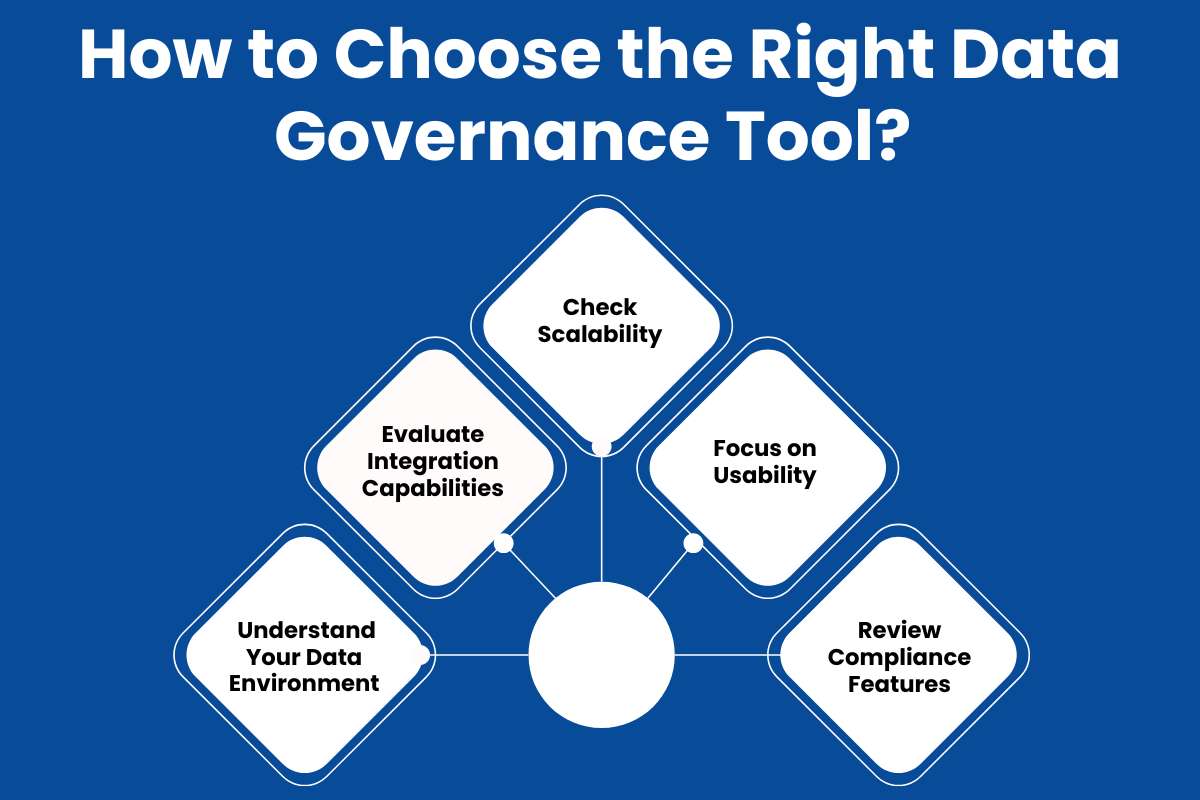
Selecting the right system for managing company data is not a quick decision. A data governance platform becomes the foundation of how a business organizes, protects, and uses its information. Because of this, companies must evaluate several factors before choosing one.
Every organization has a different data environment. Some rely heavily on cloud platforms, while others still use traditional databases. Some companies handle sensitive customer information and must follow strict regulations. Others focus more on analytics and reporting.
For these reasons, businesses should carefully compare data governance tools before selecting one. A well-chosen platform improves data accuracy, strengthens security, and makes daily work easier for teams across the organization.
Below are the most important factors to consider when selecting the right solution.
1. Understand Your Data Environment
Before choosing any technology, organizations must first understand their current data landscape.
Many companies store data in multiple locations. Customer data may exist in CRM systems. Financial data may sit in accounting platforms. Marketing data may live inside analytics tools or cloud applications.
Without a clear view of these systems, selecting the right governance platform becomes difficult.
Companies should map out where their data exists and how it moves between systems. This process helps identify gaps, risks, and areas where better control is needed.
Once the data environment becomes clear, organizations can evaluate which data governance tools support those specific systems. Some platforms work best with cloud infrastructures, while others perform better in hybrid or on-premise environments.
Understanding the current data structure ensures the chosen tool fits the business instead of forcing the business to adapt to the tool.
2. Evaluate Integration Capabilities
Modern companies rely on many digital tools to run their operations. Databases, analytics platforms, marketing software, financial systems, and cloud services all generate data every day.
Because of this complexity, integration becomes a critical factor when choosing governance software.
The best data tools connect smoothly with existing systems. They collect metadata, track data flows, and maintain governance policies across multiple platforms without disrupting operations.
Strong integration capabilities allow businesses to:
- Track data movement between systems.
- Maintain consistent data standards.
- Avoid creating isolated data silos.
- Ensure accurate reporting across departments.
If the governance platform cannot connect to important systems, the company may lose visibility over critical information. Therefore, compatibility with current infrastructure should always remain a top priority during evaluation.
3. Check Scalability
Data growth never slows down. Every customer interaction, online transaction, marketing campaign, and internal process generates new information.
A platform that works well today may struggle tomorrow if it cannot handle increased data volume.
Scalability refers to the ability of a system to grow with the business. Reliable governance tools should handle expanding datasets, additional users, and new systems without losing performance.
Businesses should look for solutions that support:
- Large data environments
- Cloud expansion
- Advanced analytics platforms
- AI and machine learning systems
A scalable governance system ensures long-term reliability. Instead of replacing the tool every few years, organizations can continue using it as their data ecosystem grows.
4. Focus on Usability
Technology only works when people actually use it.
Many governance platforms fail because employees find them confusing or difficult to navigate. If teams struggle to understand the system, they may ignore governance processes altogether.
Effective data governance tools should provide a simple and intuitive interface. Employees should easily search for datasets, understand data ownership, and access relevant information without technical barriers.
Usability becomes especially important for departments such as marketing, sales, finance, and operations. These teams rely on data daily but may not have technical expertise.
User-friendly governance tools improve adoption across the organization. When teams understand how the platform works, they follow governance policies more consistently and maintain better data quality.
5. Review Compliance Features
Data regulations continue to grow worldwide. Governments enforce strict rules about how organizations collect, store, and protect personal information.
Industries such as finance, healthcare, and technology must follow detailed compliance requirements. Failure to meet these standards can lead to financial penalties and damage to brand reputation.
This is why compliance features play a major role when comparing governance tools.
A strong governance platform should help organizations:
- Track sensitive data
- Control access to confidential information
- Maintain audit trails for regulatory reviews.
- Document governance policies clearly
These features simplify the process of demonstrating compliance during internal audits or regulatory inspections.
By using governance software with strong compliance capabilities, organizations reduce risk and build greater trust with customers and partners.
Future Trends in Data Governance Tools
Data governance continues to evolve as businesses rely more on analytics and artificial intelligence.
Several important trends are shaping the next generation of data governance tools.
- AI-Driven Governance: Artificial intelligence helps automate classification, risk detection, and metadata management within governance tools.
- Real-Time Data Monitoring: Businesses now expect instant insights. These modern tools track data quality and security in real time.
- Cloud Native Platforms: Many organizations operate in cloud environments. Future data tools will prioritize cloud integration and scalability.
- Self-Service Data Access: Teams want faster access to trusted data. Advanced governance tools allow users to search and access datasets easily while maintaining security controls.
Conclusion
Remember the messy spreadsheet war from the introduction? Numbers everywhere, nobody trusting the reports, and every meeting ending with “Which file is correct?”
That chaos disappears when companies build a structured data strategy.
Modern organizations rely on data governance tools to organize information, protect sensitive data, and maintain accuracy across systems. When teams trust their data, decisions become faster and smarter.
In a world driven by analytics and automation, data governance tools are not optional anymore. They are the quiet systems that keep the entire data engine running smoothly.
FAQs
1. What are data governance tools used for?
They help organizations manage data quality, security access, and compliance across databases and analytics systems.
2. Who uses data governance tools?
Large enterprises, banks, healthcare organizations, government agencies, and technology companies commonly use them.
3. Are data governance tools only for large companies?
No. Small and medium businesses also benefit from structured data governance, especially when data grows quickly.
4. Do data governance tools improve data quality?
Yes. They help detect errors, enforce data standards, and maintain consistency across systems.
5. What is the difference between data governance and data management?
Data governance defines policies and rules, while data management handles the technical processes of storing and processing data.